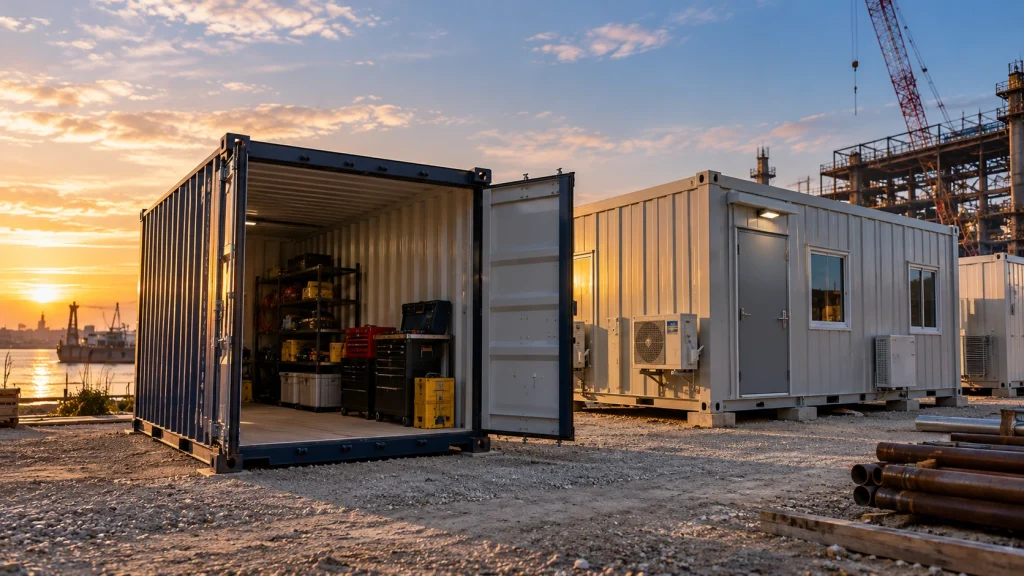
A standard ISO container covers ground-level storage on accessible sites without modification. A custom-modified container is what you need when the unit has to function as a workspace, house electrical systems, or operate reliably in Gulf Coast heat and humidity. The choice comes down to what the container has to do once it’s placed, not what it costs on the initial quote.
Key Takeaways
- Standard ISO containers are built for storage. They’re not built for personnel use, electrical housing, or occupied workspace in Gulf Coast conditions without modification.
- Custom containers arrive ready to perform a function, with HVAC, insulation, interior finishes, electrical rough-in, and specialized access points built in before delivery.
- Short-notice delivery is available for standard units. Custom containers require fabrication lead time, and that gap is a real variable when your timeline is fixed.
- Choosing the wrong container type doesn’t save money. It costs more through workarounds, rework, and delays that compound across project phases.
- ManCo Rentals & Sales fully discloses the condition of all used containers before delivery. No surprises on delivery day.
What Does a Standard ISO Shipping Container Actually Cover?
A standard ISO shipping container is a steel-framed, weatherproof enclosure built to international intermodal specifications. ManCo Rentals & Sales offers both 10-foot and 20-foot units, available new or used, for rental or purchase.
For on-site storage, that profile is often exactly right. Tools, materials, documents, and equipment stay under cover and behind a lock. The container sits at ground level, accepts heavy loads, and can be moved while loaded, which matters on active job sites where the layout shifts as construction phases progress. There’s no system to maintain and no interior finish to protect. You place it, you load it, you lock it.
What a standard container isn’t is a workspace. If your site team needs to work inside it, review drawings in it, run communications from it, or house any electrical distribution equipment, you’re asking for a storage enclosure to perform a job it was never built for. That gap doesn’t announce itself on delivery day. It shows up as daily friction and improvised workarounds that build on each other over weeks.
Reviewing the container rental options available for your project type is a practical first step in narrowing down whether a standard or custom unit fits what your site actually requires.
Where Standard Containers Create Problems on Active Gulf Coast Sites
Here’s what most buyers don’t think through until after delivery. A steel enclosure with no insulation and no climate control becomes functionally unusable as a workspace for most of the working year across Louisiana, Mississippi, Texas, and Alabama. Ambient temperatures stay elevated well into fall. Humidity is constant. There’s no comfortable wait-it-out window.
That’s not a minor inconvenience. It means your site team ends up working out of a vehicle or a separately sourced trailer, both of which cost more and solve less. The problem adds cost every day and it isn’t resolved.
The same logic applies to electrical housing. Motor Control Center rooms, the enclosures designed to house electrical control and distribution systems for heavy industrial equipment, can’t be improvised from a standard container. They require specific ventilation configurations, panel clearances, conduit access points, and sometimes fire-rated materials. None of that comes factory-standard.
Consider an illustrative situation on a mid-size industrial site: a site manager might need a field office for daily coordination and a separate enclosure for electrical switchgear. Ordering two standard containers and retrofitting them in the field would likely raise safety questions, consume labor that wasn’t budgeted, and could easily cost more in total than ordering purpose-built units from the start. The retrofit path might look cheaper on the initial quote. By project closeout, that’s rarely how it works out.
It’s also worth knowing what site access variables affect container delivery in Louisiana before the delivery conversation happens. Tight clearances or soft ground affect whether any container, standard or custom, can reach its placement zone on the day it’s needed.
When Custom Containers Earn Their Cost
Custom-modified containers are built to a spec before they leave the fabrication facility. Insulation, HVAC, windows, doors, interior finishes, electrical rough-in, lighting: these go in at the build stage, not in the field after delivery. When the unit arrives on your site, it’s ready to perform from day one.
For data center construction, AI compute farm buildouts, and large solar installations, the on-site office and control infrastructure has to function reliably from the moment it’s placed. The site manager’s office needs to be operational the morning after delivery. A control room needs to safely house equipment from the first shift. There’s no ramp-up period on an active project.
ManCo builds custom units for job site offices, operational control rooms, and Motor Control Center rooms for industrial operations across the Gulf Coast region. Fabrication takes place at the Eunice, Louisiana facility. Units arrive ready to use, not ready to be finished.
That said, custom isn’t the right answer for every situation. If you need temporary overflow storage for materials during a single construction phase on an accessible site, a standard container handles that job well. You shouldn’t pay for a fully finished interior you’ll never use.
The practical frame is straightforward: custom containers earn their cost when the unit has to perform a function. Standard containers earn their cost when the unit has to hold something.
For a closer look at how modification options work in practice, this overview of container modifications in Louisiana covers the most common configurations and what they involve.
A Decision Framework: Function Before Footprint
Before you call anyone for a quote, work through this sequence.
What is this unit doing?
Storage only, or active use by personnel or equipment? The answer to that question determines whether you’re looking at a standard or custom unit. Everything else follows from there.
What conditions will it operate in?
Any human-occupied space on the Gulf Coast needs insulation and climate control. A unit that performs fine in a mild month won’t perform the same way during peak summer heat. If you’re planning a multi-month deployment, design for the hardest conditions the site will see, not the most comfortable ones.
What does site access actually allow?
Tight clearances, soft or unstable ground, overhead obstructions, and active traffic patterns all affect which delivery method can reach the placement zone and how the container can be set. Confirm this before the order is placed, not after the truck arrives.
What’s the real timeline?
Standard containers are available for short-notice delivery because no fabrication is required. Custom containers involve a build process with lead time attached. If your project window is tight, that gap belongs in the conversation from the first call.
ManCo coordinates delivery using tilt-bed or flat-bed transport, with weekday and weekend delivery both available as real options. On active construction sites, weekend delivery is often the only practical way to place a container without disrupting ongoing site operations or running into access restrictions. Container sizing and dimensions are worth confirming before that conversation, too.
Acting vs. Waiting: What the Decision Actually Costs
The comparison that matters isn’t standard versus custom on price alone. It’s what happens when the wrong unit ends up on-site, or when the decision gets deferred until the only options left have a catch attached.
| Decision Point | Acting with ManCo | Waiting or Going It Alone |
|---|---|---|
| Container fit for purpose | Unit confirmed to spec before delivery | Risk of receiving a unit that can’t do the job |
| Gulf Coast workspace readiness | Climate control and insulation built in before delivery | Bare steel, unusable for personnel in heat and humidity |
| Delivery flexibility | Weekday and weekend delivery both available | Limited to supplier’s schedule with no site accommodation |
| Condition transparency | Full upfront disclosure on used container condition | Surprises after the unit is already on-site |
| Fabrication lead time | Known at order, built into project schedule | Unknown until it becomes a scheduling problem |
| On-site workarounds | None required when unit is built to spec | Added labor and cost from retrofitting what wasn’t built right |
| Project timeline impact | Contained and managed | Compounds across phases |
The cost of the wrong container isn’t the monthly rental rate. It’s the cost of everything that has to happen to work around a unit that can’t perform the job you placed it to do. By that measure, the right container is always the less expensive choice.
What Custom Containers Don’t Resolve
Custom containers are the right answer for a wide range of active job site situations. They’re not the right answer for every situation.
If your site has access restrictions that prevent standard delivery equipment from reaching the placement zone, that’s a logistics problem no container configuration resolves on its own. Sites with low overhead clearances, genuinely unstable ground, or traffic patterns that can’t pause for placement need a site assessment before any order is placed.
Permitted structures are a separate category. A container placed on a permanent foundation in a jurisdiction that treats it as a structure rather than portable equipment may require permits that change the timeline and cost picture. If your project has that profile, confirm the regulatory requirements for your specific location before selecting a container solution.
On used containers specifically: ManCo fully discloses conditions before delivery. Dents, surface rust, seal condition, and any structural considerations are communicated upfront. You make the decision with complete information. There are no surprises when the unit arrives. That transparency is part of how ManCo has operated as a National Portable Storage Association member since 2007.
When you’re ready to work through what your specific site needs, ManCo Rentals & Sales can walk you through the options directly. You can also review how ManCo supported a large-scale data center project for a concrete picture of how that process works on a demanding build.
Frequently Asked Questions
How do I know whether I need a custom container or a standard one?
The deciding factor is what the unit has to do. If it’s storage only on an accessible site with no climate or electrical requirements, a standard ISO container handles the job. If anyone will work inside it, or if it needs to house equipment with specific environmental, ventilation, or electrical requirements, a standard container isn’t built for that use. Start with function, not price.
What’s the actual lead time difference between standard and custom containers?
Standard containers are available for short-notice delivery because no fabrication is involved. Custom containers require a build process at the fabrication facility, which adds lead time that should be built into your project schedule from the start. If your timeline is tight, that gap is a real variable and it belongs in the conversation before you commit to a configuration.
Can a container be repositioned after it’s placed on my site?
Yes. ISO containers can be moved while loaded, which is practically useful on construction sites where the layout changes as phases progress. The logistics of moving a placed container depend on site access and what’s inside it, but the container itself is designed for repeated transport.
What sizes does ManCo offer for rental or purchase?
ManCo Rentals & Sales offers 10-foot and 20-foot ISO containers. The right size depends on what you’re storing or housing and how much footprint the site allows. For office and control room applications, the 20-foot configuration is the more common choice.
Is weekend delivery a real option?
Weekday and weekend delivery are both real options. On active construction sites, weekend delivery is often the only practical way to place a container without disrupting ongoing site operations or running into access restrictions. Confirm your specific delivery window when you place the order.
What does full disclosure on used container conditions actually mean in practice?
It means you receive accurate information about the container’s condition before it’s delivered. Dents, surface rust, seal condition, and any structural considerations are communicated upfront so you can make the decision with complete information. There are no surprises when the unit arrives on your site.
How does pricing work for standard versus custom containers?
Pricing depends on configuration, rental or purchase terms, and project specifics. Contact ManCo directly for current availability and rates. The more useful frame for evaluating cost is this: the right container, sized and configured correctly for your project, costs less than the workarounds and delays that follow from the wrong one placed on a tight timeline with no room to recover.
Ready to confirm what your site actually needs? Reach out to ManCo Rentals & Sales with your project timeline, site access details, and configuration requirements. The right answer usually becomes clear in the first conversation.
About the Author
Brett Manuel is the President of ManCo Rentals & Sales, Inc., a Louisiana-based provider of ISO shipping containers, portable storage, office containers, and custom container modifications. He oversees operations across the Gulf Coast region, working with commercial, industrial, construction, agricultural, and government clients on container solutions for storage and on-site workspace needs. ManCo Rentals & Sales has been a member of the National Portable Storage Association since 2007.