When coordination breaks down on an active job site, the missing piece is usually a functional workspace. An ISO container configured for on-site office use can be delivered, placed, and operational in a single visit with no foundation required. But the window to make that happen cleanly is shorter than most project schedules account for.
Key Takeaways
- ISO container offices deliver at ground level with no foundation or site prep required, placed in a single visit
- Containers can be repositioned while fully loaded, which matters on phased projects where the workspace location needs to shift
- ManCo offers 10-foot and 20-foot units, both new and used, with full upfront condition disclosure on every used container
- Weekday and weekend delivery is available across Louisiana and the Gulf Coast region
- The right fit depends on your timeline, site access, phase mobility needs, and whether you need a standard or custom-built workspace
What Actually Goes Wrong When the Office Situation Falls Apart on a Job Site?
The surface problem is no functional workspace on-site. The real problem is that the decision got made too late, and every option still on the table at that point has a catch attached to it.
Temporary workspace rarely gets treated as a sequencing decision. Most project managers treat it like a logistics task: order the unit when the need gets obvious. But by the time it’s obvious, lead time has already shrunk. The crew is improvising. Coordination is slipping. The options that would’ve been clean two weeks earlier now come with delays you can’t afford.
The wrong on-site office doesn’t fail loudly. It fails through compounding friction, and that friction costs more across the remaining project than the rental ever would have.
Why Does This Keep Happening on Otherwise Well-Run Projects?
It’s a sequencing problem that gets treated like a logistics problem.
Logistics thinking says: order the unit when you need it. Sequencing thinking says: the unit has to be in place before the work that depends on it starts. That means ordering before the need is visible to anyone standing on-site.
There’s also an option-confusion problem. A container office and a modular building look similar on a spec sheet. They perform very differently on an active site with shifting access points, phased work zones, and a crew that needs a workspace that actually functions rather than one that technically qualifies.
Project managers who’ve worked through this before know the gap between “we can probably arrange that” and “it’s on your site Tuesday.” That gap is where projects lose time they don’t recover.
What Are the Real Options, and When Does Each One Make Sense?
ISO Container Office
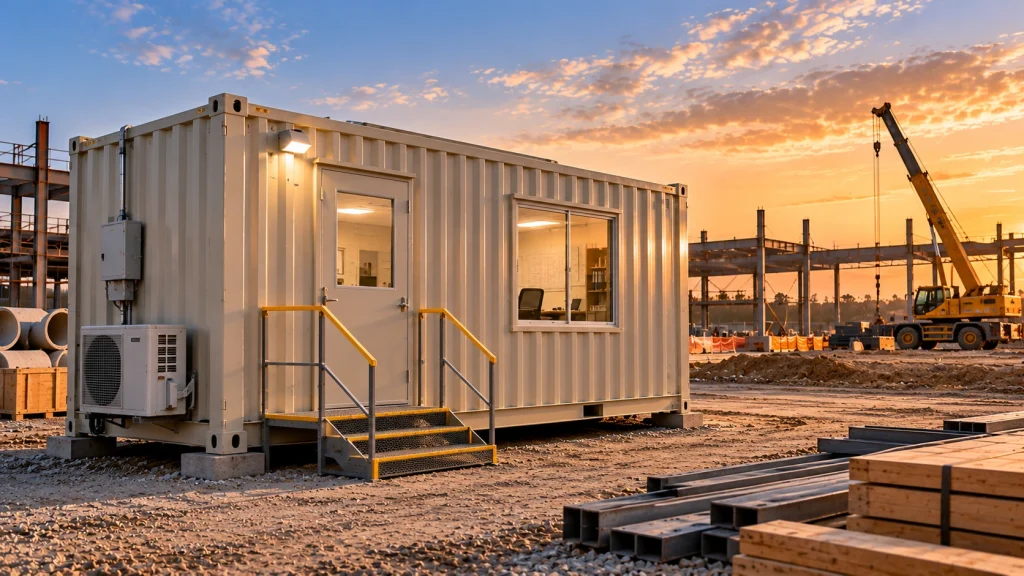
An ISO container office is a 10-foot or 20-foot steel container configured for workspace use. It arrives by tilt-bed or flatbed transport and sits at ground level without a foundation. Delivery and placement happen in a single visit, with no foundation pour, no block prep, and no separately scheduled ramp.
On active sites where the office location may need to shift as phases move, containers can be repositioned while fully loaded. That detail matters more in practice than it sounds. You don’t unstock the unit, stage everything somewhere, and reload when the next phase starts. The office moves with the project.
Custom configurations can include HVAC, electrical, insulation, windows, shelving, and fully finished interiors. The range of what’s available is wider than most buyers expect the first time they call. You can review the full scope through ManCo’s rental options.
For a solar installation, data center build, or infrastructure project across Louisiana where phases shift and site access changes over the project lifecycle, a ground-level container office handles the full run without requiring you to re-solve the workspace problem at each transition.
The piece on portable job site office buildings covers the scenarios where container offices consistently outperform other options.
Modular or Portable Building
A modular building offers more square footage per unit and feels closer to a permanent office environment. It’s the right choice when your site is fixed, your timeline is long, and your crew size justifies the footprint.
The tradeoff is real. Setup takes longer. The unit typically requires a prepared pad or block foundation. Repositioning mid-project is a separate, involved logistical operation. If your build has a stable layout and enough lead time, a modular building is worth comparing directly. If you’re working a fast-moving build with shifting access points, the setup requirement becomes a hard constraint, not a minor inconvenience.
Job Site Trailer
A trailer is familiar and widely available. For short-duration projects with simple coordination needs, it works. The limitations surface as the project extends. Trailers aren’t engineered for Gulf Coast heat and humidity the way a properly insulated container is. They’re harder to secure. They don’t adapt well when the workspace needs to handle multiple functions simultaneously. If the office needs to double as a coordination hub, document storage, and a technical workspace, a trailer reaches its limits quickly.
Improvised or Last-Minute Arrangements
This option appears when no proper unit was ordered in time. The crew works around the gap. The cost in lost coordination, makeshift setups, and compounding delay almost always exceeds what a rental would have run. It looks free until you add it up.
Four Variables Worth Running Before You Commit to Anything
Timeline. If you need the unit on-site within a few days, a container is your most realistic option. Modular buildings require more lead time. ManCo delivers weekdays and weekends, which gives you scheduling flexibility that most regional suppliers don’t offer.
Site access. Can a tilt-bed truck reach your placement point? Low overhead clearance, soft ground, or restricted entry points need to surface before delivery is scheduled. ManCo works through access requirements upfront so issues get identified before the truck arrives, not during placement.
Phase mobility. Will the office need to move as the project progresses? Containers move while fully loaded. Modular buildings generally don’t, without a separate logistics operation that takes time you may not have.
Configuration requirements. Do you need a basic lockable workspace, or do you need HVAC, finished walls, electrical, and specific interior layouts? Standard containers handle the first. Custom-built units handle the second. The right answer starts with a conversation about what the unit actually needs to do on your specific site, not a catalog selection.
If two or more of those variables point toward a container, that’s your answer. Exploring the rental options alongside a direct conversation about your site specifics is the fastest way to confirm fit.
What “Custom” Actually Means on an Active Industrial Site
Consider a project running across multiple sites that needs more than one type of on-site workspace. Personnel need a coordination office. Process management requires a climate-controlled environment. Electrical control and distribution equipment needs an enclosure built to specific access and ventilation requirements.
A standard container handles none of those out of the box, because none of them start with the same operational requirements. A custom-built unit addresses each requirement specifically, because the build begins with what the unit needs to do rather than with a generic shell dropped on a site.
That’s the difference between a container that gets placed and one that actually functions as working infrastructure from day one. ManCo’s process starts by identifying operational requirements before any build or delivery is confirmed. That’s not a customer service distinction. It’s the only way a custom unit performs reliably on a demanding industrial site without becoming a problem you’re managing around.
For a closer look at how ManCo approaches large-scale, multi-site infrastructure builds, the news section covers the range of project types the company has supported across the Gulf Coast region.
The Honest Limitation
Container offices don’t fit every situation.
If your site has terrain restrictions, low-clearance power lines above the placement point, or ground conditions that can’t support delivery equipment, a container can’t be placed safely. That’s a hard limit, not a workaround scenario.
If you need more than 20 feet of contiguous open floor space in a single structure, a container has a ceiling. Multiple units can be placed adjacent to one another, but if single-structure open square footage is a firm requirement, a modular building is the right answer.
Calling that out isn’t a concession. It’s how ManCo makes sure what gets delivered is the right unit for your site and not a solution that creates new problems. ManCo has been a member of the National Portable Storage Association since 2007. That membership reflects a consistent standard: transparent condition disclosure on all used units before you commit, direct delivery logistics, and a process that confirms the right solution before the order is placed. For a closer look at evaluating used containers, the guide to spotting quality in used shipping containers covers what to ask before you sign anything.
Comparison: Acting With ManCo vs. Waiting or Going It Alone
| Factor | With ManCo Rentals and Sales | Waiting, improvising, or ordering too late |
|---|---|---|
| Delivery timing | Weekday and weekend, single-visit placement | Dependent on when the decision finally gets made |
| Foundation required | No, ground-level placement with no site prep | Improvised structures often require unplanned site work |
| Phase mobility | Containers move while fully loaded | Improvised setups don’t relocate cleanly or quickly |
| Custom configurations | Full range from standard to specialized builds | Limited to whatever’s available last-minute |
| Gulf Coast performance | Properly insulated units built for the climate | Trailers and improvised structures vary widely |
| Condition transparency | Full upfront disclosure on all used units | Condition unknown until delivery is already underway |
| Total project cost | Predictable rental or purchase terms | Delay and rework costs compound across the remaining project |
FAQ
How quickly can a container office be delivered to a site in Louisiana?
ManCo delivers weekdays and weekends across Louisiana and the Gulf Coast region. For sites with clear truck access, delivery and placement happen in a single visit. The specific timing depends on your location and site conditions, which is why that conversation happens before delivery is scheduled.
What’s the difference between a standard container office and a custom-built one?
A standard container gives you a lockable steel unit at ground level. A custom unit adds what makes it a functional workspace for your specific operation, including HVAC, electrical, insulation, windows, and finished interior configurations. The starting point is always a conversation about what the unit actually needs to do on your site.
Can a container office be repositioned after it’s set up and stocked?
Yes. Containers can be moved while they’re fully loaded. That matters on phased projects where the workspace needs to shift as work progresses. It’s one of the practical differences between a container and a modular building, where repositioning requires a separate and more involved operation.
Do I need to prepare the ground before delivery?
Not the way a modular building requires. Containers sit at ground level without a foundation. The site should be reasonably level and accessible for the delivery truck. ManCo works through access requirements before scheduling so issues get identified before the truck arrives, not during placement.
What’s the difference between a new and a used container, and how do I know what condition it’s in?
ManCo offers both new and used ISO containers and fully discloses the condition of all used units upfront before you commit. A used container in good condition performs the same way a new one does for most applications. You’re not guessing at what you’re getting when you make the decision.
Is a 20-foot container always the better choice for a job site office?
Not always. A 10-foot unit works well for a single-person coordination office or a combined workspace and document storage setup. A 20-foot unit makes more sense when multiple people are working in the space at the same time, or when equipment needs to share the footprint. Size should follow actual use, not a general preference for more room.
What happens at the end of the rental period?
ManCo coordinates pickup the same way it coordinates delivery: directly, with clear scheduling. If your project runs longer than originally planned, flexible rental terms mean you’re not locked into a contract that doesn’t match how construction timelines actually work. If you decide to purchase the unit rather than return it, that option is available for both new and used containers.
If your project is approaching the phase where on-site workspace becomes a real constraint, the time to sort out the details is before that constraint hits. Contact ManCo Rentals and Sales to talk through your site, your timeline, and the right configuration for what you’re building.
Brett Manuel is the President of ManCo Rentals and Sales, LLC, a Louisiana-based provider of ISO shipping containers, portable storage solutions, office containers, and custom container modifications. He oversees the company’s operations across the Gulf Coast, helping commercial, industrial, construction, agricultural, and government clients secure durable container solutions for storage and on-site workspace needs. ManCo Rentals and Sales has been a member of the National Portable Storage Association since 2007 and serves clients from its Eunice, Louisiana facility across the Gulf Coast region and beyond.