You’ve got a site to run, a schedule that doesn’t bend, and a storage or workspace problem that needs to be solved this week, not next month. The container rental process looks simple from the outside. It rarely is once you’re in it.
ISO containers are steel intermodal freight units built to international standardization specifications that make them stackable, towable, and structurally consistent across suppliers. For construction, oilfield, agricultural, and municipal operators, they’re the most practical form of on-site storage and workspace available. But the standard rental approach, meaning a generic unit on a generic term with no modification and no flexibility, breaks down fast when your site conditions don’t match what the supplier assumed.
Key Takeaways
• Standard container rentals fail most working sites not because containers are the wrong product, but because the delivery, configuration, and term structure weren’t designed for field conditions
• The three most common failure points are access logistics, unit configuration, and lease rigidity – each one compounds the others
• Buying outright isn’t always smarter than renting; the right answer depends on how long you’ll need the unit and what happens to it after
• Custom-built units (job site offices, control rooms, MCC enclosures) require a supplier with fabrication capacity, not just a container yard
• ManCo Rentals & Sales has served Gulf Coast operations since 2007 as an NPSA member, with direct delivery and custom fabrication available across Louisiana and Texas
What’s Actually Breaking Down When a Container Rental Goes Wrong?
The surface symptom is usually a delay or a mismatch. The unit arrives and the floor plan doesn’t work. The delivery window doesn’t align with site access. The lease term locks you in for six months on a three-month project. You end up paying for something that doesn’t fit and can’t be changed.
The structural reason this happens is that most container rental transactions are designed around storage depots, not active job sites. The supplier’s model assumes you’ll take a standard unit, park it somewhere flat, and leave it alone. That assumption fails the moment you’re on a gravel pad in a frac sand operation, a municipal construction corridor, or a multi-site farm with seasonal access constraints.
The root cause isn’t the container itself. It’s asset mismatch: acquiring a permanent or semi-permanent solution configured for a generic use case when your actual requirements are specific, time-bound, and variable.
Why Does the Standard Rental Model Fail Industrial and Field Operations?
Three failure points show up consistently, and they’re not independent. They compound each other.
Delivery logistics. A container is only useful if it can get to where you need it. Weekend access, narrow site entries, soft ground, and remote locations all create delivery problems that standard suppliers aren’t equipped to handle. If your supplier only runs weekday deliveries and your site goes live Saturday, you’ve already lost a day.
Unit configuration. A plain 20-foot or 40-foot box is fine for storing materials. It’s not a job site office. It’s not a control room. It’s not a Motor Control Center enclosure designed to house electrical distribution systems for heavy industrial equipment. When your operation needs those things, a standard rental catalog doesn’t help you.
Lease rigidity. Most rental terms are structured around the supplier’s inventory management, not your project timeline. You get locked into a fixed duration that either runs short or runs long, and adjusting mid-contract is either expensive or impossible.
Each of these is solvable. None of them gets solved by going to a supplier who only does one of the three.
The Three-Layer Infrastructure Problem: A Framework for Getting This Right
The Three-Layer Infrastructure Problem is a decision framework for matching container solutions to field requirements across three dimensions: access, configuration, and duration.
Use it before you call any supplier.
Layer 1: Access. Can a delivery truck reach your site? What’s the pad condition? Do you need weekend delivery? What’s the unloading method? If any of these answers are “complicated,” your supplier needs direct delivery capability and scheduling flexibility, not a third-party logistics handoff. Avoiding costly delays with expert container transport starts with asking these questions before you sign anything.
Layer 2: Configuration. What does the unit actually need to do? Plain storage is Layer 2 simple. A finished interior office with HVAC, electrical, and a restroom is Layer 2 complex. An MCC room with conduit penetrations, panel mounting, and industrial-rated ventilation is Layer 2 specialized. Know which one you need before you get a quote, because the supplier who can do simple can’t always do specialized.
Layer 3: Duration. How long do you actually need it? If it’s under 12 months and the project ends cleanly, renting is almost always the right call. If you’re building permanent infrastructure or running a multi-year operation across multiple sites, the math shifts toward buying or buying with customization. The honest answer on rent vs. buy: less than most people buy, and more than most people rent.
A common scenario: a construction project manager needs three units across two sites for eight months, one for tool storage, one as a site office, and one as a secure document room. A standard rental handles the first. The second requires a finished interior. The third requires a lockable, climate-controlled enclosure with specific access control. Three different configuration requirements, one supplier relationship. If that supplier can’t do all three, you’re managing two vendors for the same project, and the coordination cost adds up fast.
If your project fits all three layers cleanly, ManCo Rentals & Sales can quote it the same day. If your configuration requirements are specialized, that’s a fabrication conversation, not a rental catalog conversation.
What Does Custom Fabrication Actually Mean for an Industrial Operation?
Custom fabrication means the unit is built to a specification, not pulled from inventory and delivered as-is. That distinction matters operationally because field-ready infrastructure has requirements that a standard ISO container doesn’t meet out of the box.
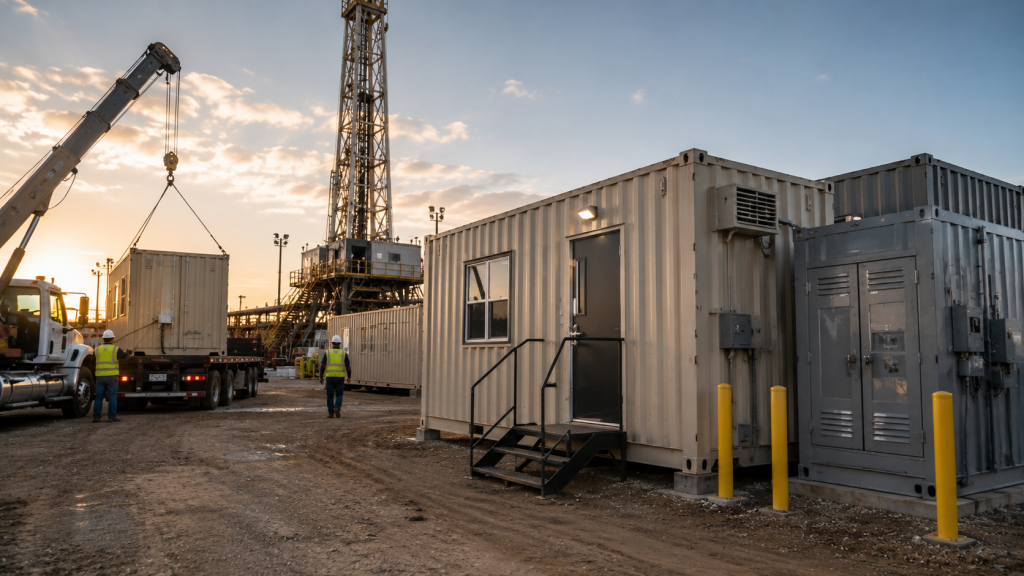
ManCo Rentals & Sales recently completed a multi-unit deployment for a frac sand mining operation spanning Louisiana and Texas, serving as the sole supplier across the entire engagement. The project required three categories of units: job site offices, operational control rooms, and Motor Control Center rooms. MCC rooms are specialized enclosures designed to house electrical control and distribution systems for heavy industrial equipment. They’re not a modified storage container. They’re a purpose-built structure with specific electrical, ventilation, and access requirements.
Eight units were built and deployed, with the final two staged at ManCo’s Eunice facility for delivery. That kind of scope, multiple unit types, multi-state deployment, demanding schedule, requires a supplier with fabrication capacity, not just a container yard. The portable job site office solutions that work for a construction trailer aren’t the same as what an oilfield control room requires.
The contrarian claim worth stating plainly: most operators underestimate their configuration requirements and overpay for the wrong unit. They rent a plain box when they need a finished space, then spend money on interior buildout that doesn’t travel with the unit. The smarter move is specifying the unit correctly before delivery, not retrofitting after.
Rent, Buy, or Customize: What Actually Makes Sense for Your Operation?
| Scenario | Right Move | Why |
| Short project (under 12 months), standard storage | Rent a standard unit | No capital tied up, unit goes back when project ends |
| Multi-year operation, permanent site | Buy outright | Ownership cost beats long-term rental cost |
| Specialized workspace (office, control room, MCC) | Rent or buy a custom-built unit | Configuration requirements can’t be met by standard inventory |
| Multi-site operation, variable timelines | Flexible lease with delivery coordination | Term rigidity is the biggest cost driver here |
| Seasonal or agricultural use | Rent with seasonal terms | Paying year-round for a unit used six months is the wrong math |
The table above is built around fit and operational math, not price. The most expensive decision isn’t choosing a supplier who charges more. It’s choosing the wrong unit configuration or the wrong term structure and paying to fix it mid-project.
You can review shipping container options for Louisiana operations or look at how to evaluate container quality before you commit if you’re weighing new versus used. Both decisions feed into the same framework.
If you’re at the point where you know what you need and you want a quote, contact ManCo Rentals & Sales directly. Weekday and weekend delivery available across the Gulf Coast region.
What Are the Real Limitations of ISO Container Solutions?
Straight answer: containers don’t solve every on-site space problem, and pretending otherwise wastes your time.
If your site has no viable delivery access, a container doesn’t help you. Soft ground, overhead clearance restrictions, or permit-restricted corridors can make delivery impossible regardless of supplier. That’s a site constraint, not a container problem.
If your workspace requirements include plumbing connections, permanent foundation work, or multi-story configuration, a container-based solution is either a partial answer or the wrong answer entirely. Shipping container modifications can handle a lot, but they don’t replace a permanent building where a permanent building is what the job actually requires.
If your need is genuinely temporary and your configuration is simple, a standard rental from any reputable supplier will work. The value of working with a supplier like ManCo Rentals & Sales comes from flexibility, fabrication capacity, and direct delivery logistics. If you don’t need those things, you don’t need to pay for them.
The right question isn’t “is a container the right product?” It’s “is this supplier configured to solve my specific version of the problem?”
Most operators who’ve had a bad container rental experience didn’t have a container problem. They had a supplier-fit problem.
FAQ
How do I know whether to rent or buy an ISO container for my project?
The decision comes down to duration and what happens to the unit when you’re done. If you need it for under 12 months and don’t have a follow-on use, renting almost always makes more financial sense. If you’re running a multi-year operation or want to keep the unit on-site permanently, buying outright costs less over time than a long rental. The break-even point varies by unit size and configuration, so ask your supplier to run the numbers for your specific timeline before you commit.
What’s the difference between a standard container rental and a custom-built unit?
A standard rental is a plain ISO container pulled from inventory and delivered as-is. It’s appropriate for material storage and basic on-site use. A custom-built unit is fabricated to a specification, which might include finished interiors, HVAC, electrical systems, conduit penetrations, or specialized enclosures like MCC rooms for industrial electrical equipment. If your operation requires workspace rather than just storage, you need to know which category you’re asking for before you get a quote.
Can a container be delivered to a remote or difficult-access site?
Yes, but not by every supplier. Remote delivery requires direct logistics capability, flexible scheduling, and equipment suited to the site conditions. Suppliers who rely on third-party carriers often can’t accommodate weekend delivery, soft-ground access, or tight site entries. Ask specifically about delivery method and scheduling before you sign a rental agreement, not after.
How long does it take to get a custom-built container unit delivered?
Standard units can typically be delivered within days of an agreement. Custom fabrication takes longer because the unit has to be built to spec before it ships. Timeline depends on the complexity of the configuration, the number of units, and the supplier’s current fabrication capacity. If you’re on a demanding schedule, the earlier you get into the fabrication conversation, the better your options.
What happens if my project timeline changes after I’ve signed a rental agreement?
This is where lease rigidity becomes a real cost. Standard rental agreements often have fixed terms with penalties for early return or extension fees for running long. Before you sign, ask explicitly about term flexibility, what it costs to extend, and what the process is for early return. A supplier who won’t answer that question clearly is telling you something.
Are used ISO containers reliable for industrial and oilfield use?
Used containers range from structurally sound with cosmetic wear to units with compromised integrity that don’t belong on an active job site. The difference is in how the supplier discloses quality. ManCo Rentals & Sales fully discloses the condition of used units before delivery, so you know exactly what you’re getting. A supplier who doesn’t offer that transparency is a risk you don’t need on a job site where equipment reliability matters.
Do I need a permit to place a container on my property or job site?
Permit requirements vary by municipality, site type, and intended use. A container used for temporary storage on a construction site is treated differently than a permanent structure in a commercial zone. Your local permitting authority is the right source for a definitive answer. What’s consistent across jurisdictions is that you’re better off asking before delivery than after, because moving a container you can’t legally place is an avoidable cost.
Ready to spec the right unit for your site? ManCo Rentals & Sales serves construction, oilfield, agricultural, retail, and municipal operations across the Gulf Coast region with direct delivery, flexible lease terms, and custom fabrication capacity. Call or request a quote to get a straight answer on what your project actually needs.
About the Author
ManCo Rentals & Sales, LLC is a Gulf Coast container solutions provider specializing in ISO container rentals, sales, and custom fabrication for on-site storage and workspace applications. They’ve served as an NPSA member since 2007, working with construction companies, oilfield operators, farms, retail businesses, and municipalities to match the right container solution to the specific demands of each job site. Based in Eunice, Louisiana, ManCo provides weekday and weekend delivery across the Gulf Coast region.