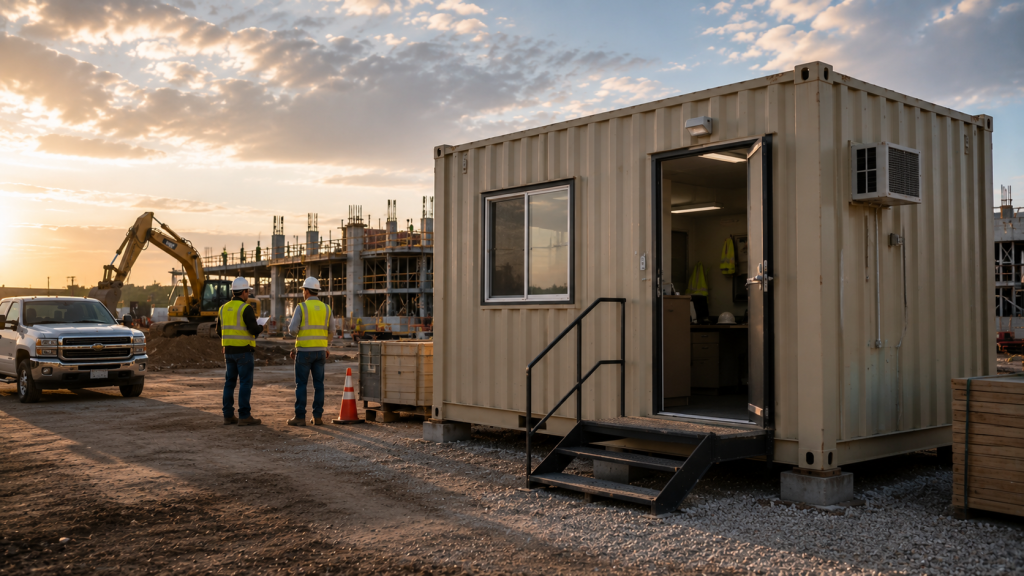
The job site is already running. Equipment is staged, crew is on-site, and you’re managing daily operations out of a pickup truck or a corner of a trailer that was never meant to serve as an office. That’s not a temporary inconvenience. That’s a compounding operational liability.
The real question isn’t whether you need a portable office solution. It’s whether waiting another week costs you more than acting today.
Key Takeaways
• Waiting to secure a portable office or storage unit isn’t a neutral decision. It carries real operational and financial cost that accumulates daily.
• The right time to act is defined by three measurable conditions: site duration, personnel count, and regulatory or safety requirements already in effect.
• Renting makes more financial sense than buying when your site timeline is under 18 months or your needs are likely to change.
• Custom-built units for industrial applications (control rooms, MCC rooms, job site offices) require lead time. Ordering after the need is obvious means you’re already behind.
• ManCo Rentals & Sales, LLC serves Gulf Coast operators with weekday and weekend delivery, flexible leasing terms, and fully disclosed quality on both new and used inventory.
What’s the Direct Answer on Timing?
Act when three conditions are present simultaneously: your site or operation will run for more than 60 days, you have personnel who need a dedicated workspace or secure storage, and you’re already absorbing the cost of not having that space in some other form (lost time, rented commercial space, unsecured equipment). Waiting past that threshold doesn’t save money. It defers a fixed cost while adding a variable one.
Why Do So Many Operators Wait Too Long to Secure On-Site Space?
The root cause isn’t budget hesitation. It’s a timing illusion.
Most project managers and site supervisors treat the portable office or storage container decision as a Phase 2 problem. Get the site running first, then sort the infrastructure. That logic makes sense on paper. On an active job site, it means you’re making personnel management, document storage, and equipment security decisions without the physical infrastructure to support them.
The timing illusion works like this: because the cost of not having a unit isn’t invoiced, it doesn’t register as a cost. Lost supervisor hours, unsecured tools, weather-damaged materials, and crew without a designated staging area all carry real dollar values. They just don’t show up on a line item.
That’s the mechanism behind the delay. Not indecision. Not budget. A cost that’s invisible until you add it up.
You can read more about how operators are rethinking on-site storage decisions in this industry perspective on construction storage from ManCo’s Brett Manuel.
What Are the Actual Signals That Mean You Should Act Now?
Three conditions define the action threshold. When all three are present, waiting is the more expensive choice.
Site duration exceeds 60 days. Below that threshold, improvised solutions might be tolerable. Above it, the cumulative cost of improvised workspace and unsecured storage outpaces the rental cost of a proper unit. Most construction, oilfield, and municipal projects run well past that mark.
You have personnel who need a fixed workspace. A site supervisor making decisions from a vehicle isn’t just uncomfortable. That person is less effective, slower on documentation, and harder to reach. A dedicated on-site office changes the operational tempo of the whole site.
You’re already paying for the absence. This is the clearest signal. If you’re renting commercial space off-site, losing billable hours to off-site document runs, or absorbing equipment loss from unsecured storage, the unit pays for itself in the first billing cycle.
A common scenario: a mid-size construction crew is three weeks into a 14-month commercial build. The project manager is driving 20 minutes each way to a leased office to handle paperwork, subcontractor coordination, and client calls. That’s roughly 40 minutes of drive time per day, five days a week. Over 14 months, that’s a significant block of supervisor hours spent in transit. A portable office placed on-site eliminates that cost entirely and keeps decision-making authority physically present on the job.
Should You Rent or Buy? The Conditions That Change the Answer
Rent vs. buy is the follow-up question almost everyone asks after deciding to act. The answer depends on one variable more than any other: certainty of use.
The Certainty-of-Use Framework works like this: if you can state with confidence that you’ll need this unit in a specific configuration for a specific location for more than 18 months, buying is worth evaluating. If either your timeline or your location is uncertain, renting preserves flexibility without sacrificing function.
Here’s how the tradeoffs look side by side:
| Condition | Rent | Buy |
| Site duration under 18 months | Lower total cost | Higher total cost, resale uncertainty |
| Multiple job sites or relocations | Flexible, redeliverable | Logistically complex, adds transport cost |
| Uncertain future needs | Adjustable mid-contract | Locked into current configuration |
| Long-term fixed location | Cost accumulates over time | Builds equity, fully customizable |
| Industrial spec requirements (MCC rooms, control rooms) | Fast deployment, spec-matched | Best for permanent infrastructure |
| Budget structure (OpEx vs. CapEx) | Operating expense, easier to approve | Capital expense, requires different approval path |
The honest answer on buying: it makes sense for operations with a permanent or semi-permanent footprint, or for businesses that need a unit configured to a specific industrial standard and plan to use it for years. ManCo Rentals & Sales offers both sales and leasing options with transparent quality disclosure on new and used inventory, so the comparison is straightforward.
If you’re evaluating used containers specifically, this guide to spotting quality in used shipping containers covers what to look for before you commit.
What Does “Custom” Actually Mean in an Industrial Context?
Custom doesn’t mean upgraded finishes. In industrial applications, it means engineered to operational spec.
ManCo Rentals & Sales recently completed a multi-state deployment for a frac sand mining operation, serving as the sole supplier across Louisiana and Texas. The project required three distinct unit types: job site offices, operational control rooms, and Motor Control Center (MCC) rooms. An MCC room is a specialized enclosure designed to house electrical control and distribution systems for heavy industrial equipment. These aren’t standard containers with added shelving. They’re purpose-built infrastructure that has to meet site-specific electrical, environmental, and safety requirements before the first crew member walks in.
Eight units were fabricated and deployed, with the final two staged at ManCo’s Eunice, Louisiana facility for delivery. That kind of project doesn’t happen without established fabrication capacity and a supply chain that can hold a demanding delivery schedule across multiple sites.
The takeaway for operations managers and facilities managers: if your project requires custom-built units, lead time is part of the spec. Ordering when the need becomes urgent means the unit arrives after the window you needed it for. The portable job site office buildings overview explains what goes into a properly equipped on-site office and what to specify when you order.
If you’re at the point of defining specs, contact ManCo Rentals & Sales to discuss what your project requires. The earlier that conversation happens, the more options you have.
What Are the Conditions Where Waiting Is Actually the Right Call?
Not every situation calls for immediate deployment. Waiting is the right call when:
Your site timeline is genuinely uncertain and committing to a unit would lock you into a configuration or location you can’t use. In that case, a short-term rental with flexible terms is better than a rushed purchase or a long-term lease on a unit that doesn’t fit.
Your project is in pre-mobilization and the site isn’t ready to receive a delivery. Ordering too early creates its own logistical problem. A unit sitting in a staging area that isn’t operational yet doesn’t help anyone.
You haven’t defined your actual requirements. A job site office for five people has different specs than a control room for an industrial operation. Ordering before those requirements are clear often means ordering twice. Understanding how to choose the right container dimensions for your project before you order can prevent exactly that kind of costly do-over.
The point isn’t that waiting is always wrong. It’s that waiting without a defined trigger condition is where costs accumulate invisibly. Set the condition in advance: “We act when the site is mobilized and the crew count exceeds X.” That’s a decision, not a delay.
What About Municipalities and Agricultural Operations? Different Timeline Logic?
Yes. The timing logic for municipalities and farms runs on a different cycle than construction or oilfield.
Municipal administrators dealing with seasonal facilities, emergency response staging, or temporary office space during facility renovations face a procurement calendar that doesn’t align with project urgency. The decision to act often has to happen weeks before the need is visible, because purchasing approvals and delivery scheduling don’t compress easily.
Farm operations face a similar dynamic. Harvest season storage needs are predictable, but the window to secure units before demand peaks is short. Ordering in the middle of peak demand means competing for delivery slots and inventory that’s already committed.
The portable storage rental trends affecting Gulf Coast operators are worth reviewing if you’re planning around a seasonal or cyclical need. The pattern is consistent: operators who secure units before peak demand have more options, better pricing leverage, and more flexibility on delivery timing.
ManCo Rentals & Sales serves municipalities, farms, and commercial operations across the Gulf Coast region with weekday and weekend delivery, which matters when your operational calendar doesn’t follow a standard Monday-through-Friday schedule.
The One Insight Worth Keeping
Waiting to secure portable office solutions feels like preserving options. It’s actually consuming them. Every day without the infrastructure is a day you’ve already paid for it in some other form.
FAQ
How far in advance should I order a portable office or storage container?
For standard units, two to four weeks of lead time is a reasonable target for most Gulf Coast operators. Custom-built units for industrial applications, including control rooms or MCC rooms, require more lead time depending on spec complexity. If your project has a hard mobilization date, work backward from that date, not forward from when you get around to ordering.
What’s the minimum site duration that makes a rental worth it?
If your operation runs 60 days or longer with personnel who need dedicated workspace or secure storage, a rental unit typically pays for itself in recovered time and reduced losses. Below 60 days, the calculus depends on what you’re currently spending to compensate for not having the space.
Can I customize a rented unit, or only a purchased one?
Customization options depend on the provider and the scope of modification. ManCo Rentals & Sales offers customization on both rental and sales units. For industrial applications requiring specific electrical, HVAC, or structural modifications, a direct conversation about your requirements is the right starting point.
What’s the difference between a standard portable office and a control room or MCC room?
A standard portable office is configured for personnel: workspace, climate control, lighting, and basic utilities. A control room is engineered to house process monitoring and operational systems. An MCC room is a specialized enclosure designed to house electrical control and distribution equipment for heavy industrial machinery. Each has distinct structural, electrical, and environmental requirements that have to be specified at the order stage.
Does ManCo Rentals & Sales deliver on weekends?
Yes. ManCo offers both weekday and weekend delivery across the Gulf Coast region. For operations with tight mobilization windows or sites that can only receive deliveries outside standard business hours, that flexibility matters.
What’s the risk of ordering a used container without seeing it first?
The main risk is receiving a unit in worse condition than expected, which creates downtime while you wait for a replacement or repair. ManCo Rentals & Sales fully discloses the quality of used inventory before delivery. You’re not guessing about condition. The guide to evaluating used container quality covers what to ask and what to inspect.
Is renting always cheaper than buying over a long project?
No. Over a long enough timeline, typically past 18 to 24 months at a fixed location, purchase economics often favor buying. The crossover point depends on rental rate, unit configuration, and whether you’ll need to relocate the unit. ManCo offers both options with transparent pricing, so the comparison is direct rather than theoretical.
If your project is past the 60-day threshold and you’re still working around the absence of proper on-site infrastructure, the decision point has already passed. Reach out to ManCo Rentals & Sales to discuss what your site requires and what delivery timeline is realistic for your schedule.
About the Author
ManCo Rentals & Sales, LLC is a Gulf Coast container solutions provider specializing in ISO shipping containers and portable office solutions for rent, purchase, and customization. They serve construction companies, oilfield operators, retail businesses, farms, and municipalities across the Gulf Coast region, delivering flexible leasing and sales options with transparent quality disclosure and weekday and weekend delivery from their Eunice, Louisiana facility. ManCo has been a member of the National Portable Storage Association since 2007.