The choice between a standard and a custom ISO container comes down to one question: is the unit storing materials, or housing operations? Answer that correctly before you order, and everything else follows. Answer it wrong, and you’ll be revisiting the decision mid-project at a cost no one budgeted for.
Key Takeaways
- Standard ISO containers are the right call for weatherproof, lockable storage and staging when no occupied use is required
- Custom containers are engineered for personnel offices, process control environments, and industrial electrical enclosures
- Choosing the wrong unit type rarely fails all at once; it creates friction, workarounds, and a mid-project swap nobody planned for
- ManCo Rentals & Sales offers both standard and custom ISO containers with weekday and weekend delivery across the Gulf Coast
- Every used container comes with full condition disclosure before you commit
What Actually Separates a Standard Container from a Custom One?
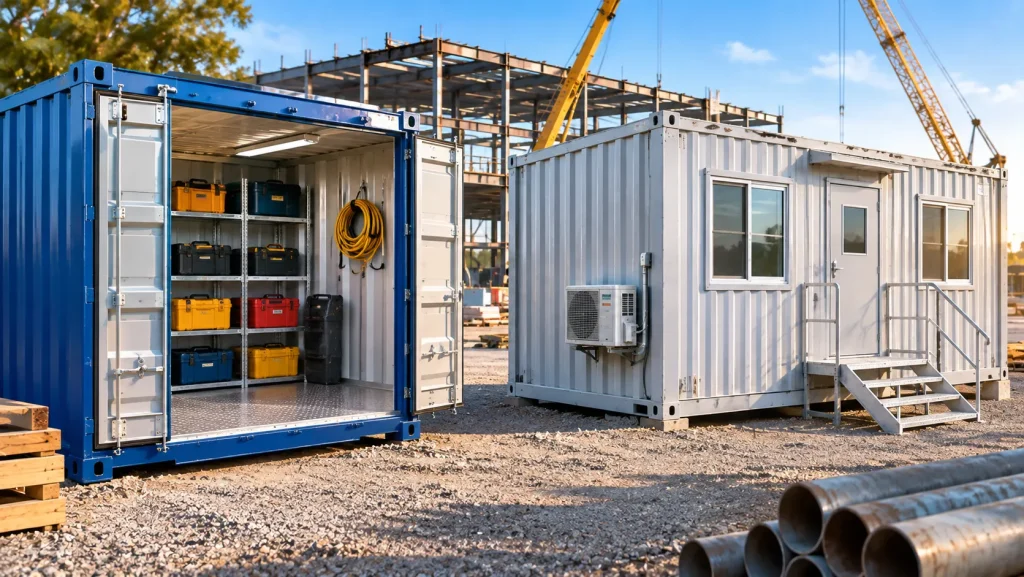
A standard ISO container is a certified steel intermodal unit built to fixed international specifications: consistent dimensions, corner castings, and lockable cargo doors. ManCo Rentals & Sales carries 10-foot and 20-foot units in both new and used condition. Every used unit comes with a full condition disclosure before you make any commitment, covering dents, surface rust, floor condition, and anything else that affects what shows up on your site.
A custom container starts from that same certified steel shell and gets fabricated to a defined use case before it leaves the yard. Modifications can include shelving, personnel doors, windows, insulation, HVAC systems, electrical panels, and fully finished interior walls. The result is a field-deployable unit built to a spec. It’s not an off-the-shelf cargo box with a window cut into it after the project is already underway.
The dividing line is this: a standard container holds things; a custom container houses operations. That distinction isn’t always obvious from a job description, but it becomes very clear once someone has to spend a full workday inside a unit that wasn’t built for it.
When Does a Standard Container Cover the Requirement?
Standard containers make sense when the requirement is containment rather than configuration. If you need weatherproof, lockable storage for materials or equipment, a standard unit deployed by tilt-bed transport handles that without fabrication costs or added lead time.
Consider what that looks like on a real project: a site superintendent managing a multi-month build needs a secure staging area for hardware and a locked space for hand tools. A standard 20-foot ISO container covers both without modification. Adding insulation and finished interior walls would add real cost across the full rental period for features the project would never use.
Standard containers are also the realistic choice when delivery speed is the priority. ManCo Rentals & Sales offers weekday and weekend delivery, and a standard unit can be staged and dispatched without waiting on a fabrication window. If your site needs a unit in place on a tight schedule, a standard container is often the only option that fits the timeline.
If you’re still working through whether to rent or purchase outright, the ISO container sales vs. rental decision guide covers that tradeoff with practical context for active projects.
When Does a Custom Container Justify the Cost?
The cost justifies itself when the alternative is a permanent structure, an off-site facility, or a workspace that doesn’t actually match what the site requires.
The clearest signal is when someone other than procurement has already written a spec. If an engineer or safety manager has produced a requirements document, a standard container won’t satisfy it, and no field workaround changes that. Motor Control Center rooms are a concrete example: purpose-built enclosures designed to house electrical control and distribution systems for heavy industrial equipment. A standard cargo-door unit can’t substitute for an enclosure that has to meet specific operational and safety requirements. Trying to make it work doesn’t just create inconvenience; it creates safety exposure on an active industrial site.
The same logic applies to occupied office space on Gulf Coast job sites. An uninsulated steel container without ventilation or climate control becomes a serious problem on a Louisiana workday in the fall or at any point during warmer months, because steel amplifies ambient heat and there’s no mechanism to dissipate it. Without HVAC and insulation, interior temperatures climb well past the point of functionality during peak hours. A finished interior with climate control isn’t a comfort upgrade in that environment. It’s what keeps the space usable when you need it. The portable office guide for Gulf Coast project managers goes deeper on this for anyone weighing on-site office options.
Custom containers also matter when placement precision is non-negotiable. ManCo coordinates delivery directly using tilt-bed or flat-bed transport, which allows for accurate positioning on active sites around heavy equipment, underground utilities, or restricted access corridors. For a closer look at what Gulf Coast project managers most commonly specify, this breakdown of popular container modifications in Louisiana covers the options with real context.
What the Cost Comparison Actually Measures
The standard container costs less. That’s accurate, and it matters. But the comparison only holds when the standard unit genuinely fits the requirement.
Here’s where the math breaks down. Consider a project manager who specs a standard container for a site that actually needs a climate-controlled on-site office. After a short time, the unit stops being functional during peak heat hours because the physics of an uninsulated steel box in Louisiana don’t change regardless of how the unit is positioned or ventilated from the outside. The crew adapts around it, which means slowing down. When the decision gets revisited, there’s now a second delivery to coordinate, a second placement on an active site, and another round of setup time while the original unit is removed. On a project where every day of delay has a direct cost attached to it, that disruption is the real expense of the wrong decision. It doesn’t show up as a clean line item. It shows up as compounding friction, and that’s harder to absorb mid-project than a rate difference would have been before the first order was placed.
The wrong container rarely fails in a single visible event. It generates schedule drag that builds on itself, and that’s the cost that’s hardest to recover from.
There’s a practical mobility factor worth noting too. ManCo’s containers can be moved while loaded. On projects where the work front shifts and infrastructure needs to follow it, that means a repositioned unit doesn’t require a full unload-and-reload cycle before transport. On a long-duration project with multiple phases, that’s a real logistical advantage that isn’t always visible until the first repositioning move.
For a full look at what to check before signing any container rental agreement, the shipping container rental terms guide for Louisiana businesses covers the questions worth asking before you commit.
Matching the Unit to the Requirement
The table below frames the choice the way it should actually be framed: not as a price comparison between vendors, but as what happens when you match the right unit to your requirement versus what happens when you don’t.
| Situation | Right Match with ManCo | Wrong Match or Delayed Decision |
|---|---|---|
| Storage and staging only | Standard ISO container handles it without added fabrication cost | Custom build adds cost for features the project doesn’t need |
| Occupied office or control room use | Custom unit with HVAC and finishes keeps personnel productive through Gulf Coast conditions | Standard unit becomes non-functional mid-day; swap required mid-project at real schedule cost |
| Industrial electrical housing | Custom enclosure fabricated to operational and safety requirements | Standard container can’t meet the requirement; field workarounds create safety exposure |
| Tight delivery window | Standard units available for rapid weekday or weekend deployment | Delaying the decision costs site readiness time regardless of which unit type is needed |
| Placement precision on an active site | ManCo coordinates tilt-bed or flat-bed delivery directly for accurate positioning | Providers routing through regional distribution networks typically have less placement flexibility |
| Mid-project repositioning | Containers move while loaded; no unload cycle required | Uncoordinated logistics add unload and reload time to every repositioning move |
ManCo Rentals & Sales has been a National Portable Storage Association member since 2007. In practice, that membership reflects a straightforward operating principle: the unit that gets recommended is the one that actually fits the requirement. If a standard container solves the problem, that’s what gets quoted.
If you’re ready to confirm availability and discuss delivery for your site, browse the current rental options or contact ManCo directly.
Where Custom Containers Don’t Apply
Custom containers require fabrication time. If your project is active and you need a unit on site within 48 hours, a standard container is your only realistic option. ManCo can stage and deploy standard units quickly, but a custom build has to be engineered and fabricated before it ships. There’s no shortcut around that window, and any provider who suggests otherwise isn’t being straight with you.
Custom containers also can’t solve site access constraints. If overhead clearance is limited, ground conditions won’t support delivery equipment, or access restrictions prevent tilt-bed transport, the container can’t reach the placement point regardless of what’s been built into it. That’s a site problem, not a container problem, and it needs to be addressed before ordering either unit type.
For projects where the requirement is genuinely simple, a custom container adds cost the project doesn’t need. Lockable, weatherproof storage for a defined period doesn’t need insulation or finished walls. A standard unit is the correct answer, and a supplier who pushes otherwise isn’t reading your project accurately.
For a broader look at how to evaluate any container provider before you commit, this guide on vetting shipping container rental providers covers the questions worth asking before you sign.
Frequently Asked Questions
How do I know whether my project needs a standard or custom container?
The clearest test is whether people are working inside the unit or just accessing materials from it. Storage and staging work fine with a standard container. Occupied office space, process control environments, and industrial electrical housing all require a custom build. If an engineer or safety manager has already written a spec, that document gives you the answer directly.
How long does custom container fabrication take for a Gulf Coast job site?
It depends on the scope of modifications. A basic office finish takes less time than a purpose-built electrical enclosure or a control room with specific cable management and penetration requirements. Lead time needs to be confirmed against your actual spec and delivery date. Contact ManCo Rentals & Sales directly with your requirement so you get an accurate answer, not a general range that may not reflect your project.
Can I rent a custom container, or do I have to purchase it?
Both options are available. ManCo Rentals & Sales offers custom-built containers on flexible rental terms and for outright purchase. Renting makes sense when your project has a defined end date and you don’t want a capital asset on the books after the site closes.
Are ISO containers weatherproof enough for Gulf Coast conditions?
Standard ISO containers are steel-walled and built to withstand the conditions of international intermodal shipping, including significant weather exposure. For occupied use in Gulf Coast conditions, a custom container with insulation and sealed penetrations for HVAC and electrical systems provides more complete weatherproofing. The article on container weatherproofing and hurricane safety in Louisiana covers the specifics for anyone with durability concerns on their site.
Can a container be repositioned after it’s placed on my site?
Yes. ManCo’s containers can be moved while loaded, which is a practical advantage on active sites where the work front shifts and infrastructure needs to follow it. Repositioning requires coordinating transport, but you don’t need to unload the unit before it moves.
What gets disclosed about used containers before I commit?
ManCo fully discloses the condition of every used container before you make any commitment. Dents, surface rust, floor condition, and any other relevant factors are part of that disclosure. What you’re told upfront is what arrives on site.
How does working with ManCo differ from a national provider?
National container companies typically route through regional distribution networks. That structure can mean longer lead times, less placement flexibility, and less direct communication when something changes on your end. ManCo Rentals & Sales is based in Eunice, Louisiana and delivers directly across the Gulf Coast, Arkansas, and surrounding regions. Weekday and weekend delivery is available. You’re working with the same team from quote through delivery through return, not a call center routing requests through a dispatch chain.
The decision between standard and custom comes down to matching the unit to what the site actually requires. Get that question right before the container is ordered, and you won’t be revisiting it mid-project.
Contact ManCo Rentals & Sales, LLC to discuss your project requirements, confirm delivery availability, and get a quote for the right unit.
About the Author
Brett Manuel is the President of ManCo Rentals & Sales, LLC, a Louisiana-based provider of ISO shipping containers, portable storage solutions, office containers, and custom container modifications. ManCo Rentals & Sales has been a member of the National Portable Storage Association since 2007 and is based in Eunice, Louisiana, serving the Gulf Coast, Arkansas, and surrounding regions.