When your project timeline compresses and on-site workspace needs to be in place before the next phase starts, the sourcing decision you make in the next 48 hours shapes how your crew operates for the rest of the build. The three main product categories in this space arrive differently, sit differently, and perform differently under real job site conditions. They’re not interchangeable.
Key Takeaways
- Ground-level ISO container offices eliminate the steps, ramps, and leveling hardware that trailer-mounted units require, which matters on active sites where equipment movement and tight clearances are daily realities.
- The right choice between a container office and a trailer-mounted unit comes down to three factors: site access and ground conditions, required placement precision, and whether the function demands custom configuration.
- Custom-built container offices can be engineered for specialized industrial functions, including HVAC systems, electrical panel integration, and conduit routing, because the ISO steel frame tolerates significant modification without compromising structural integrity.
- ManCo Rentals & Sales has been a National Portable Storage Association member since 2007, offers weekday and weekend delivery, and holds a one-month minimum rental with no hidden fees.
- Waiting to sort out on-site workspace until after other logistics are confirmed is one of the most costly sequencing errors on mid-size Gulf Coast builds.
What’s the Straight Answer on Portable Office Buildings?
For mid-size construction projects on the Gulf Coast where site access is constrained, placement precision matters, or the function requires custom configuration, a ground-level ISO container office is the most practical choice. Trailer-mounted modular units work on open, flat sites with standard layouts. Stick-built temporary structures are rarely worth the cost or setup time on a project with a defined end date. The right category depends on your specific site conditions, not general preference.
Why Does the “Portable Office” Category Create So Much Confusion?
The term covers at least three physically different products. A vendor who uses the same language for all of them isn’t simplifying your decision. They’re hiding the details that will either make delivery smooth or hand you a site management problem you didn’t anticipate.
The three categories are:
- Trailer-mounted modular offices: wheeled units that sit elevated on a chassis, requiring leveling blocks, steps or a ramp for entry, and sometimes a permit for extended placement
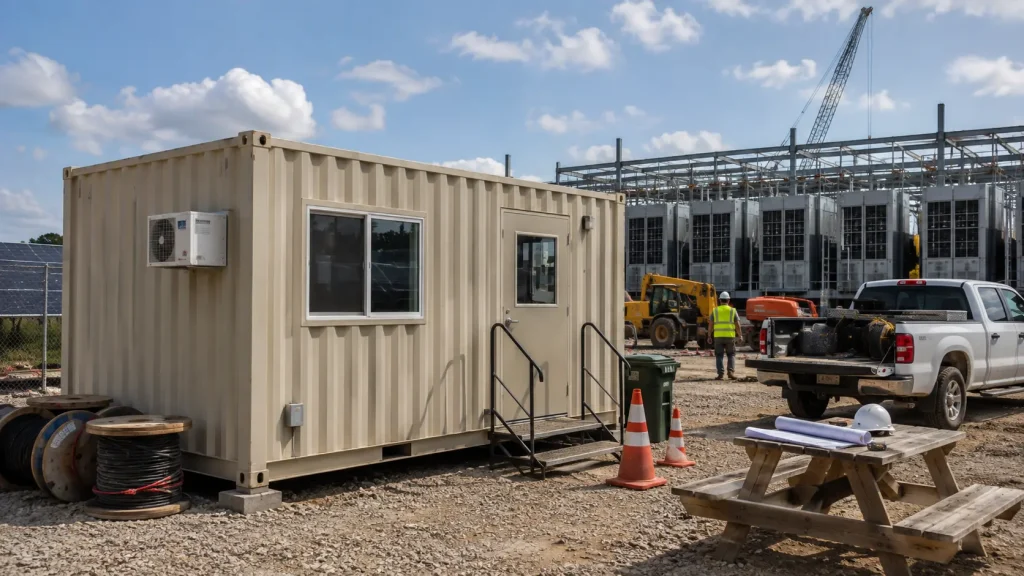
- Ground-level container offices: ISO shipping containers modified with windows, personnel doors, insulation, HVAC, and interior finishes, placed directly on the ground by a tilt-bed or flat-bed delivery truck
- Temporary modular buildings: multi-section assemblies closer to a prefab structure, typically reserved for longer-duration, higher-headcount applications
Each product carries a different delivery requirement, a different site footprint, and a different cost structure. The confusion compounds because vendors frequently describe all three using the same marketing language. If a vendor can’t explain exactly how the unit arrives, how it gets placed, and what the ground preparation requirements are before the truck rolls, that’s a signal worth taking seriously.
What Does Ground-Level Placement Actually Change on a Working Site?
This is the question most buyers skip until they’re watching a delivery go sideways.
Trailer-mounted units arrive on wheels and sit elevated. Entry requires steps or a ramp. The unit needs a leveled pad or a blocking system underneath it. The footprint extends beyond the unit itself because the chassis and hitch require surrounding clearance. On an active data center build, solar installation, or oilfield operation where equipment is moving and every square foot is already allocated, that clearance requirement isn’t a minor inconvenience. It’s a real constraint.
A ground-level container office is placed directly on the surface. No chassis. No elevated profile to route foot traffic around. A tilt-bed truck backs in, tilts the bed, and the container slides off into position. The delivery method allows a degree of placement precision that a trailer-mounted unit physically can’t match because the chassis geometry and hitch clearance are fixed, not the container.
Consider a common situation on an active industrial site. A site manager needs a personnel office placed within a tight footprint between established equipment staging areas. A trailer-mounted unit needs open clearance to maneuver, unhitch, and level before it can be occupied. A 20-foot or 40-foot container office, in most cases, goes where the truck can access because the delivery method doesn’t carry the same surrounding clearance requirements. On a site where every square foot is committed, the wrong placement call on delivery day carries costs that far exceed any monthly rental difference.
ManCo works directly with the site contact to confirm access routes and ground conditions before scheduling delivery. That’s how you avoid the second-truck problem.
How Do the Options Stack Up?
The monthly rate is the number most buyers compare first. It’s also the least useful number for making a sound decision.
| Decision Factor | Working With ManCo Container Office | Waiting, Going It Alone, or Using an Unqualified Provider |
| Placement precision | Tilt-bed delivery to a specific footprint with minimal surrounding clearance | Trailer chassis and hitch require open maneuver space and a level pad |
| Site prep required | Minimal, with blocking or cribbing for uneven terrain | Leveling hardware, steps or ramp, possible permit costs |
| Custom configuration | HVAC, electrical integration, conduit routing, custom layouts available | Standard trailer layout with a low modification ceiling |
| Delivery timing | Weekday and weekend availability across the Gulf Coast region | National provider lead times may not align with your schedule |
| Rental term flexibility | One-month minimum, no hidden fees, major credit cards and bank transfers accepted | Quarterly commitments common with larger national vendors |
| Cost of getting it wrong | Fit confirmed before the truck is dispatched | Retrofit costs, site delays, or a second delivery charge |
The real cost isn’t the monthly rate. It’s what you spend correcting a placement that didn’t work, waiting on a unit a national vendor couldn’t deliver on your schedule, or retrofitting a standard trailer for a function it wasn’t built to handle. You can review ManCo’s container rental options to get a clear picture of available configurations before you call to confirm current availability.
When Does a Custom-Built Container Office Make Sense?
This is where the container category separates from the trailer category entirely.
A trailer-mounted office is a standard product. You can add furniture and a window AC unit. What you can’t do is engineer it to house electrical control and distribution systems for heavy industrial equipment. You can’t configure it as an operational control room with specific ventilation requirements, conduit routing, and panel clearances. The trailer chassis sets a structural ceiling on what modification is actually feasible.
A custom-built ISO container office gets fabricated to spec, and that’s possible because of what the ISO steel frame is. It tolerates significant modification without compromising load-bearing capacity. That means you can cut openings for conduit, add HVAC penetrations, reinforce the floor for equipment weight, and finish the interior to whatever standard the function demands.
For project managers sourcing portable job site office buildings for specialized industrial functions, this structural distinction is often the whole decision. Think about what energy operations require: personnel offices that hold up in harsh outdoor conditions, control room enclosures with specific ventilation demands, and electrical housing built to accommodate distribution equipment. None of those functions fit inside a standard trailer layout. Trying to make them fit costs more than a purpose-built unit would have.
ManCo’s capacity to fabricate units to spec across all three of those categories reflects exactly the kind of scope a standard product line can’t accommodate. If your application is in energy or heavy industry, the gap between a standard rental and a custom-engineered container isn’t a luxury difference. It’s a functional one.
The Contrarian Position on “Flexibility”
Trailer-mounted units get marketed as the flexible option because they’re on wheels. That framing doesn’t hold up on most active construction sites.
Wheels mean elevated. Elevated means steps. Steps create a physical barrier between your crew and the workspace they’re supposed to use throughout the workday, and a tripping hazard in heavy-traffic areas. The genuine usefulness of a wheeled unit is narrow: it matters when you need to relocate the unit under its own transport power without calling in a delivery truck, and when that move happens on a frequent short-haul cycle. Outside that specific scenario, a container office placed by a tilt-bed truck is the more practical choice. It goes precisely where you position it and stays there without ongoing leveling maintenance.
The job site doesn’t slow down while you sort out your logistics.
When a Container Office Isn’t the Right Call
If your site isn’t accessible to a tilt-bed or flat-bed delivery truck, a container office won’t work regardless of how well it fits every other requirement. Low overhead clearance from power lines, bridges, or heavy tree canopy can prevent delivery. Ground that can’t support the container’s loaded weight without a prepared surface is a real constraint, though blocking, cribbing, or a gravel pad resolves it in most cases.
Container offices also aren’t the right tool if you need to relocate the unit every few days across long distances on a frequent short-haul cycle. They’re designed for placement stability. If your project requires a unit that moves with the work front on a tight recurring schedule, a trailer-mounted office is genuinely better suited to that specific use case.
ManCo is direct about this. The guidance in ManCo’s container transport planning resources can help you frame the right site access questions before you call. And ManCo’s consistent approach to transparent container condition disclosure carries through to delivery logistics. If a site genuinely can’t support container delivery, you find out before the truck is scheduled, not after it arrives.
ManCo has also documented its work supporting large-scale infrastructure projects in the region, including container supply for Meta’s data center build in Louisiana, which reflects the kind of short-notice delivery requirements and active-site logistics that mid-size construction projects face regularly.
FAQ
How quickly can a container office be delivered to a Gulf Coast project site?
ManCo Rentals & Sales offers weekday and weekend delivery across the Gulf Coast region, including Louisiana, Texas, Arkansas, and surrounding states. Delivery timing depends on unit availability and confirmed site access. The earlier you contact the team, the more scheduling options are available. Call ManCo directly at 877-915-7368 or 337-457-0101 for current availability.
Can a container office be placed on uneven or unprepared ground?
A ground-level container can be placed on moderately uneven terrain using blocking or cribbing to level it. That process is typically simpler and faster than leveling a trailer-mounted unit. Extremely soft or unstable ground may require a prepared gravel pad or timber mats. ManCo works with the site contact to confirm ground conditions before scheduling delivery so there are no surprises on the day.
What’s the difference between a standard container office and a custom build?
A standard container office typically includes a personnel door, basic ventilation, and lockable entry. Custom builds can include HVAC systems, electrical panels, insulation, windows, finished interior walls and flooring, lighting, and specialized configurations for industrial functions including control rooms and electrical housing enclosures. The scope of a custom build reflects what the function requires, not a markup on a standard unit.
Is a one-month rental actually available, or is that just the floor on a longer contract?
The minimum rental period through ManCo is one month, and that’s a real option, not a stated minimum that defaults to quarterly in practice. For projects with variable timelines, that means you’re not carrying months of rental cost you didn’t use. Rental terms are confirmed upfront with no hidden fees. ManCo accepts major credit cards, debit cards, and bank transfers.
How do container offices hold up in Gulf Coast heat and humidity?
An uninsulated container in direct Gulf Coast sun heats up fast. For occupied use, that’s not a comfort issue alone. It’s a safety concern and a risk to any sensitive equipment inside. Custom units built for personnel use include insulation and HVAC systems sized for the container volume and regional climate. If you’re using a standard unit for storage, heat is manageable. If people or sensitive equipment are inside it, specify HVAC from the start. The storage and condition considerations covered in ManCo’s container guidance are worth reviewing if you’re in the early planning stage.
What container sizes does ManCo offer for office applications?
ManCo offers 10-foot, 20-foot, and 40-foot ISO containers. For most on-site office applications, a 20-foot unit provides enough floor space for a small crew office or supervisor station. A 40-foot unit handles larger layouts including multi-desk configurations, meeting areas, or combined office and storage functions. Choosing the right size starts with your actual site footprint and headcount requirements, not a default selection. The container dimensions guide on ManCo’s site can help you work through the tradeoffs before you call.
Does ManCo serve data centers, AI compute farms, and solar project sites specifically?
Yes. ManCo has supplied container solutions to large-scale energy and technology infrastructure projects across the Gulf Coast region, and the company’s experience with active industrial sites, short-notice delivery requirements, and custom-built units for specialized functions makes it a direct fit for data center, AI compute farm, and solar installation projects at the mid-size construction scale. ManCo’s NPSA membership since 2007 reflects a consistent track record in the portable storage and workspace sector. If your project is in energy or heavy industry and your workspace requirements go beyond what a standard product line can handle, that’s exactly where custom container fabrication earns its cost.
If your project is moving and you need on-site office or storage space that arrives on your schedule, placed where you need it, with no hidden fees and a rental term that matches your timeline, call ManCo Rentals & Sales at 877-915-7368 or 337-457-0101. Weekday and weekend delivery is available across Louisiana and the Gulf Coast region. ManCo is located at 310 South Bobcat Drive, Eunice, LA 70535.
About the Author
Brett Manuel is the President of ManCo Rentals & Sales, LLC, a Louisiana-based provider of ISO shipping containers, portable storage solutions, office containers, and custom container modifications. He oversees the company’s operations across the Gulf Coast, working directly with commercial, industrial, construction, and energy sector clients to deliver container solutions built for working job sites. ManCo Rentals & Sales has been a member of the National Portable Storage Association since 2007 and operates out of Eunice, Louisiana, serving clients from Arkansas to the Gulf states.