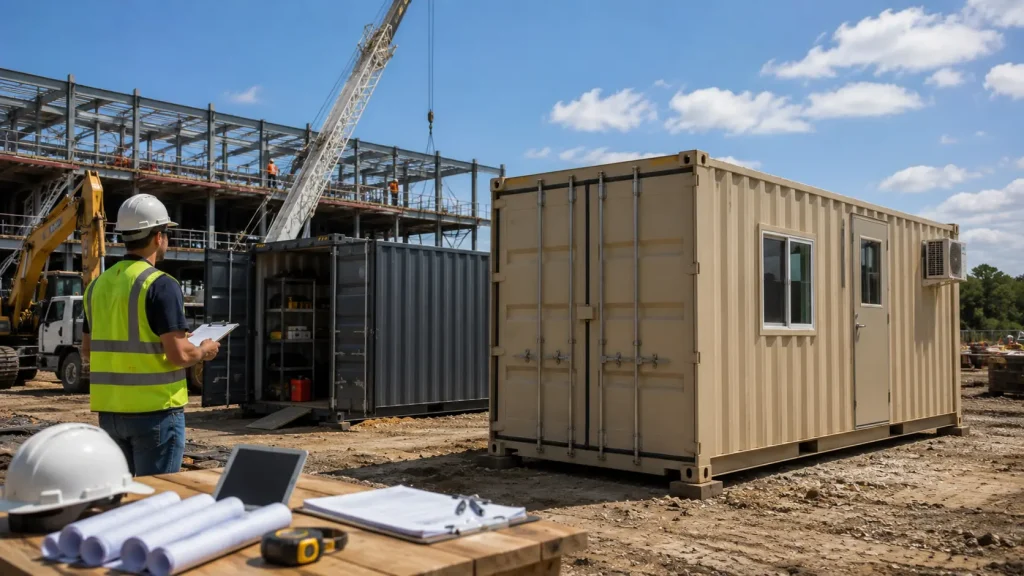
The container is already in the plan. The question most project managers answer too quickly is whether they’re paying for it the right way. Renting versus buying isn’t a philosophical debate. It’s a math problem with a time variable, and the variable is harder to pin down than it looks before you sign anything.
Key Takeaways
- Renting makes practical sense when your project timeline runs under 18 months or when site conditions are likely to shift before completion
- Buying makes sense when you have a confirmed long-term need, fixed specs, and capital that won’t strain project cash flow
- Custom containers, including job site offices, control rooms, and MCC rooms, carry a real fabrication investment, so the rent-versus-buy calculation deserves more scrutiny before you commit
- ManCo Rentals & Sales offers weekday and weekend delivery, no hidden rental fees, and transparent condition disclosure on both new and used containers
- The wrong decision isn’t choosing one option over the other. It’s choosing without honestly accounting for your actual deployment window
What’s the Direct Answer?
Rent when your need is project-specific, temporary, or uncertain in duration. Buy when you have a confirmed long-term need, typically beyond 18 to 24 months, with stable site conditions and available capital. For most mid-size construction projects across the Gulf Coast, including data center builds, solar projects, and AI compute farms, renting carries less risk and fewer logistics burdens once the project wraps.
Why Does This Decision Feel Simpler Than It Actually Is?
The surface question is “rent or buy?” The real question underneath it is how long you actually need this, and what happens if that changes.
Consider a situation that could arise on a data center build: what looks like an 18-month project on paper might pick up several weeks of permitting delay, then a second phase could get approved mid-build. A container rented for one year might end up on-site for three. The math shifts quietly, and by the time you notice, you’ve already locked into the wrong structure.
The reverse could happen just as easily. Consider a solar development scoped at 24 months where containers get purchased for on-site storage and a field office. If that project wraps ahead of schedule, you might find yourself owning containers you don’t need on a site you’re leaving, carrying transport costs to move them somewhere useful.
Neither of these is presented as a guaranteed outcome. They’re illustrative examples of the kind of timeline mismatch that makes this decision harder than it first appears. The point isn’t which option is cheaper in isolation. It’s which option is cheaper given what you actually know at the moment you’re committing.
What Does Renting Cover That Buying Doesn’t?
Renting an ISO container isn’t deferred ownership. It’s a structurally different solution.
When you work with ManCo’s rental options, you’re not just paying for a box. You’re paying for a container at a specific place, at a specific time, under specific conditions, with the ability to walk away cleanly when the job ends. That flexibility has measurable value on any active job site where conditions shift.
The rental model removes several cost categories that purchasing doesn’t address. There’s no asset disposal problem when the project closes. There’s no transport cost to relocate a purchased unit to your next site. There’s no carrying cost if your next project doesn’t start on schedule. Container condition is fully disclosed before delivery, with no hidden fees attached to the rental. Weekday and weekend delivery is available, coordinated directly around your site schedule.
ManCo offers 10-foot, 20-foot, and 40-foot ISO containers. The right size depends on your storage volume, your site footprint, and whether the unit needs to function as workspace, pure storage, or something more specialized. ManCo works through those requirements with you before you commit to anything.
One detail worth knowing: ManCo has been a member of the National Portable Storage Association since 2007. That membership means their container condition standards and operational practices are held to an industry benchmark that many regional suppliers don’t maintain. You’ll know exactly what’s arriving on your site before the truck leaves Eunice.
When Does Buying Actually Make Sense?
Buying wins when your need is durable, your specs are fixed, and you’re not paying a long-term premium to solve a recurring problem on a rotating project basis.
Consider a typical situation where a company operates across multiple project sites over a multi-year development pipeline, using the same container configuration on each deployment. When the specs don’t change and the sites keep coming, purchasing and redeploying units is a legitimate strategy. The per-unit economics improve with each additional deployment, once you account for transport cost and familiarity with the asset.
The calculus shifts when custom container modifications are involved. Insulation, HVAC, interior finishes, electrical panels, and specialized enclosures for Motor Control Center rooms are fabrication investments that take real time and planning. If those specs are permanent and carry forward cleanly to your next deployment, buying the custom unit makes sense. If the project ends and the spec doesn’t transfer, you’ve purchased a specialized asset with limited resale value and no obvious next use. Renting a custom build keeps that asset off your books when the project closes.
ManCo builds and delivers both paths. New and used containers are available for purchase or lease, with full condition disclosure either way. Custom fabrication is available for purchase or rental. The right answer depends on your deployment window, your capital position, and whether your specifications repeat across projects.
The Rent-or-Buy Decision Framework
Before you commit to either path, work through these conditions honestly:
| Condition | Rent | Buy |
| Project duration under 18 months | Yes | No |
| Project duration over 24 months, same site | Consider | Yes |
| Custom build for a single-phase project | Yes | No |
| Custom build with repeatable specs across projects | Rent first; buy if specs confirm | Yes |
| Multiple sites, same container configuration | Depends on transport cost | Yes, at three or more deployments |
| Uncertain or likely-to-shift project timeline | Yes | No |
| Capital constrained at project start | Yes | No |
| Short-notice or weekend delivery required | Yes, ManCo delivers both | Not a factor after purchase |
This table doesn’t make the decision for you. It forces you to answer the questions that actually drive the right answer, instead of defaulting to whichever option feels more permanent or more decisive.
What Does Getting This Wrong Actually Cost?
The real cost isn’t the monthly rate.
It’s the cost of being locked into the wrong structure when your project conditions shift. A purchased container that needs to relocate to a new site requires transport. On a 40-foot unit moving across state lines, that’s a real line item on a project budget that’s already under pressure. A rented unit at the end of a project gets picked up by ManCo. The asset, and the logistics burden that comes with it, stays their responsibility to manage.
Here’s something most container vendors won’t say directly: owning the asset is not always the power position. On a project site with changing conditions, a vendor who retrieves the container at project close is removing a problem from your plate, not just closing a transaction.
For context on how supply conditions affect container availability across the Gulf Coast, ManCo has addressed how it manages inventory through tightening supply environments. That context matters when you’re planning a purchase that depends on availability at a specific time.
Acting with ManCo vs. Waiting or Going It Alone
| Scenario | Acting with ManCo | Waiting or Going It Alone |
| Delivery timeline | Weekday and weekend delivery available, coordinated directly | Third-party logistics add lead time and uncertainty |
| Container condition | Fully disclosed before delivery, no surprises on arrival | Condition varies with no guaranteed pre-delivery transparency |
| Flexibility if timeline shifts | Rental terms accommodate changes; no asset stranded on a closed site | Purchased asset requires transport, storage, or resale when plans shift |
| Custom build support | Spec review, fabrication, and delivery handled in-house | Brokered builds involve handoffs and reduced accountability |
| Hidden fees | None on rentals | Common with brokered or volume-discount providers |
| Project end logistics | ManCo retrieves the unit | You own the asset and its relocation problem |
Waiting to decide isn’t a neutral position. Every week an active project site runs without adequate storage or office space adds friction that compounds across the schedule. Portable job site office buildings reduce that friction from the first day of deployment, not after you’ve absorbed several weeks of workarounds.
A Note on Custom Containers for Industrial Projects
ManCo recently completed a multi-unit deployment for a frac sand mining operation spanning Louisiana and Texas, serving as the sole supplier for the entire operation across both states.
The project involved fabricating and delivering custom job site offices, operational control rooms, and Motor Control Center rooms across multiple active sites. Six units had been delivered at the time of this writing, with two additional units staged at the Eunice facility and scheduled for deployment.
That scope reflects the kind of infrastructure work ManCo is built to support: units engineered to spec, delivered on a demanding schedule, across more than one state. It’s also a practical reference point when you’re evaluating whether a Gulf Coast container supplier can handle your actual project requirements, not just a standard rental transaction.
You can also review how ManCo has supported large-scale data center construction in the region, including container supply for Meta’s data center build in Richland Parish, to get a clearer picture of what large-deployment coordination looks like in practice.
For a broader look at how storage container solutions work across Louisiana project sites, that resource covers the practical considerations before you commit to a configuration.
What This Approach Doesn’t Cover
Container delivery requires a clear access path for tilt-bed or flat-bed transport. If your site has terrain restrictions, overhead clearance issues, or active safety exclusion zones around the placement point, that’s a conversation to have before scheduling. ManCo works through placement requirements with you in advance, but access constraints that aren’t disclosed early can delay an otherwise ready delivery.
If your operation requires a national brokerage model using third-party logistics networks, ManCo isn’t that. They own their inventory and coordinate delivery directly. For most Gulf Coast project sites, that’s an operational advantage. For operations that specifically require a brokered national model, it’s worth knowing upfront.
And if your need is genuinely one-time and under 30 days, the minimum rental period of one month is the relevant floor.
FAQ
How quickly can ManCo deliver a container to a job site in Louisiana?
ManCo offers weekday and weekend delivery across the Gulf Coast region, including Louisiana and nearby states. Exact lead time depends on your location and current inventory. Short-notice delivery is a standard part of their operation. Call 877-915-7368 or 337-457-0101 to confirm availability for your site and timeline.
What sizes of ISO containers does ManCo offer?
ManCo offers 10-foot, 20-foot, and 40-foot ISO containers for both rental and purchase. The right size depends on your storage volume, your site footprint, and whether the unit needs to function as workspace or pure storage.
What’s the difference between a standard rental and a custom container rental?
A standard rental is a clean, lockable ISO unit delivered to your site for storage or general use. A custom rental involves fabrication work such as insulation, interior finishes, windows, additional doors, electrical systems, HVAC, or specialized enclosures for control rooms or MCC applications. Pricing varies by scope and configuration. Contact ManCo directly for a quote specific to your project.
Can I rent a container for just one month if my project wraps up early?
Yes. The minimum rental period is typically one month. That’s the floor, without locking you into a longer commitment when your end date isn’t fixed. That flexibility is one of the structural advantages of renting over buying when project timelines are uncertain.
How do I know what condition a used container is in before delivery?
ManCo fully discloses container conditions before delivery. Their practice is transparent quality disclosure on both new and used units, so you know exactly what’s arriving on your site. If you want to understand the quality variables before that conversation, this guide on spotting quality in used containers covers what to look for before you commit.
Do I need to arrange my own transport, or does ManCo handle delivery?
ManCo coordinates delivery using tilt-bed or flat-bed transport. You can also arrange your own pickup from their Eunice facility if that fits your logistics better. For most active job sites, having ManCo handle delivery is the lower-friction option because they can place the unit precisely where you need it on arrival, without requiring a third-party handoff.
What’s the process for getting a custom container built?
ManCo works through the spec requirements with you first, confirms the fabrication scope, and builds the unit at their Eunice facility. Delivery is coordinated once the unit is complete and inspected. The frac sand mining deployment described above is a practical reference point for scope, sequence, and what it takes to meet a demanding delivery schedule across more than one active location.
Ready to determine the right container option for your project? Contact ManCo Rentals & Sales at 877-915-7368 or 337-457-0101, or visit them at 310 South Bobcat Drive, Eunice, LA 70535. ManCo accepts major credit cards, debit cards, and bank transfers. Weekday and weekend delivery is available, and there are no hidden fees on any rental.
The job site doesn’t wait for your storage solution to catch up.
About the Author
Brett Manuel is the President of ManCo Rentals & Sales, LLC, a Louisiana-based provider of ISO shipping containers, portable storage solutions, office containers, and custom container modifications. He oversees operations across the Gulf Coast, helping commercial, industrial, construction, agricultural, and government clients secure durable container solutions for storage and on-site workspace needs. ManCo Rentals & Sales has been a member of the National Portable Storage Association since 2007.