Your crew is on-site, the work is moving, and you still don’t have a functional office or secure storage in place. The question isn’t whether you need a container solution. It’s whether buying a used conex box or renting a portable office container is the right call for this specific project. The answer depends on four variables most buyers don’t run until after they’ve already committed.
Key Takeaways
- For shorter-duration projects, renting a portable office container keeps capital free and eliminates the post-project burden of moving or disposing of a unit you own.
- Buying a used ISO container makes the most sense when you have a confirmed long-term use for the unit after the project ends and you’ve verified its condition before delivery.
- ManCo Rentals & Sales fully discloses the condition of every used container upfront, before the transaction closes.
- Weekday and weekend delivery is available across Louisiana and the Gulf Coast, which matters when timelines compress.
- The condition of a used container is the variable most buyers underestimate. A unit that passes a visual check can still fail once it’s carrying equipment or personnel.
What’s the Direct Answer?
For projects with shorter timelines or uncertain end dates, renting a portable office container typically costs less in total and arrives faster than buying a used conex box and arranging modifications. For longer projects with a clear post-project plan for the container, buying can produce better long-term value, provided you’ve verified the unit’s condition before it reaches your site.
Why Does Buying a Used Conex Box Seem Like the Obvious Move?
The reasoning is straightforward: skip the monthly rental cost, own the asset, done. It pencils out on paper. The problem is that the purchase price is only the first number in a longer equation, and most buyers don’t finish running that equation until they’re already past the point of turning back.
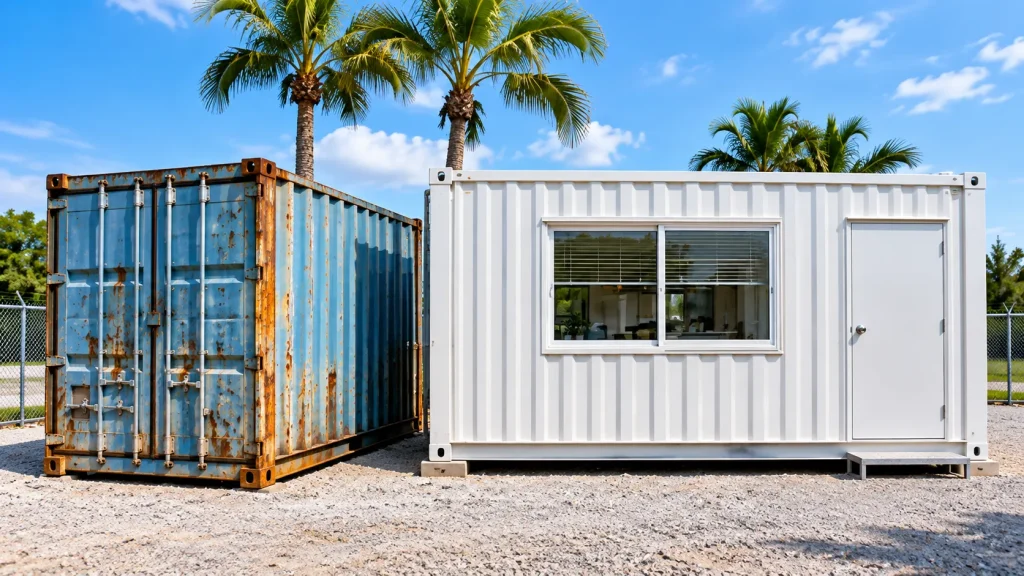
A used ISO container deployed in Gulf Coast conditions needs a real inspection before it goes to work. Rust at the corner castings, compromised door seals, and floor damage from moisture infiltration are not cosmetic problems. A container that looks acceptable from ten feet away can fail the moment you put control equipment, documentation systems, or personnel inside it. At that point, you’re not just dealing with a bad purchase. You’re dealing with a delay on an active job site, which carries its own cost in schedule compression and crew coordination.
ManCo Rentals & Sales discloses the condition of every used container before any transaction closes. That practice exists because discovering a problem after delivery is exactly the kind of delay the purchase was supposed to prevent. If you’re evaluating suppliers and want specific questions to ask about condition disclosure before you commit, the guide to evaluating shipping container rental providers covers what to look for.
What Does “Portable Office Container” Actually Mean?
“Portable office building” describes a wide range. At one end, it’s a bare 20-foot ISO box with a folding table. At the other, it’s a fully finished workspace with insulated walls, flooring, climate control, electrical service, and dedicated circuits for workstations and communications equipment.
The specification matters because it determines cost, delivery timeline, and whether the unit actually solves the problem. For data center construction, AI compute farm buildouts, and solar projects across Louisiana and the Gulf states, the on-site office typically needs to function as more than a place to sit. You may need document control capability, coordination space for multiple personnel, or a setup that supports the electrical and communications load of an active project hub.
Consider a site where a project manager needs to support three or four people working simultaneously, with dedicated circuits for field laptops and a printer, climate control for summer heat, and lockable access for sensitive documentation. A standard storage container doesn’t get there. A customizable container built to those specs does, and the modification work is reflected in the rental rate rather than added to a purchase you have to manage yourself.
ManCo Rentals & Sales offers both standard ISO containers for secure on-site storage and fully finished portable office units with custom modifications, available in 10-foot and 20-foot configurations.
What Does the Total-Cost Comparison Actually Look Like?
The standard mental model is: buying costs more upfront but less over time; renting costs less upfront but more over time. That model is correct in general terms. In practice, it breaks down quickly when you add the real variables on the purchase side.
| Decision Factor | Buying a Used Conex Box Without a Supplier Partner | Renting Through ManCo Rentals & Sales |
|---|---|---|
| Upfront capital required | Higher, purchase price plus modification costs | Lower, rental rate only |
| Condition risk | Buyer assumes it if not disclosed upfront | ManCo discloses condition before transaction |
| Modification responsibility | Buyer coordinates and pays separately | Customization handled through ManCo |
| Delivery speed | Depends on seller inventory and schedule | Weekday and weekend delivery available |
| Post-project burden | Buyer must sell, store, transport, or scrap | Return at end of rental term |
| Flexibility if project scope changes | Low, you own a fixed asset | High, terms can flex with the project |
| Right choice for shorter-duration projects | Typically not, capital tied up with no exit | Yes, capital stays available for the project |
| Right choice for longer projects with post-project use | Yes, if condition is verified before purchase | Also available for purchase through ManCo |
The point at which buying produces better value than renting depends on how long the project runs and what the unit costs to modify, transport, and eventually relocate or sell. That calculation is specific to the project, not a universal rule. What is consistent: the purchase side of that equation almost always contains more costs than buyers initially plan for.
If you’re working through the financial comparison for a specific project, the ISO container sales versus rental decision framework walks through the variables in more detail.
When Does Buying a Used ISO Container Make Sense?
Buying makes sense under a specific set of conditions, and they’re worth naming exactly.
You’re a buyer when: the project has a long timeline, you have a confirmed use for the container after the job ends (another site, permanent storage, resale), you have the time and internal resources to manage modification work before deployment, and you’ve verified the unit’s condition through a real inspection rather than a seller’s description.
One practical advantage of an ISO container is that it can be moved while loaded. That portability gives it flexibility a permanent structure doesn’t have, which is part of why containers work well for multi-phase projects where site layouts shift. ManCo offers both new and used containers for purchase, with full condition disclosure on used units so there are no surprises after delivery.
For a deeper look at how to frame that decision for a specific project, the custom versus standard ISO container comparison for Gulf Coast project managers is worth reviewing before you commit.
Where Most Suppliers Fall Apart: Short-Notice Delivery
Project timelines compress without warning. A subcontractor finishes early, a permit clears faster than expected, or a phase shift moves the site office need from next month to this week. A supplier who can’t respond to that compression isn’t a logistics partner. They’re a scheduling variable you can’t control.
ManCo Rentals & Sales serves the Gulf Coast from Eunice, Louisiana, with weekday and weekend delivery available. That’s not a marketing feature. It’s the operational reality that determines whether your site office is in place when the crew shows up or whether you’re making calls that don’t get answered until the schedule has already slipped.
For project managers across Louisiana, Mississippi, Texas, Arkansas, and the broader Gulf states, proximity to a supplier with real regional coverage matters more than a national brand that routes your request through a regional subcontractor. The gap between those two options doesn’t just create inconvenience. It creates schedule risk on a job where every day of delay has a cost attached to it.
Details on site-access requirements and delivery logistics for Louisiana projects are covered in the portable office buildings resource for Gulf Coast project managers.
What This Approach Doesn’t Cover
Portable office containers, bought or rented, don’t work for every site. Locations with low overhead lines, soft ground that won’t support tilt-bed delivery, or access roads too narrow for standard transport require either site preparation before placement or a different solution entirely.
A container office also isn’t a substitute for a permitted permanent structure when zoning or project specifications require one. If your project has specific permitting requirements in Louisiana, reviewing the Louisiana shipping container regulations guidance before committing to a configuration is worthwhile.
ManCo containers are built for ground-level, temporary to semi-permanent deployment on active sites. They’re a strong fit for most construction, industrial, and project applications across the Gulf Coast. They’re not the right answer for sites with physical access restrictions or where permanent building code compliance is required.
Frequently Asked Questions
How fast can a portable office container be delivered to a Gulf Coast job site?
ManCo Rentals & Sales offers weekday and weekend delivery across Louisiana and the broader Gulf Coast region. Actual lead time depends on container availability and site access conditions. Calling the team in Eunice with your location and timeline will get you a real answer faster than any general estimate.
What’s the practical difference between a standard rental container and a custom office container?
A standard rental container is a bare ISO box for secure on-site storage of tools, materials, or equipment. A custom office container has been modified for human occupancy, with finished walls, flooring, HVAC, electrical service, windows, and a personnel door. The cost difference reflects the modification work. Which one you need depends on whether the space has to function as a workspace or just secure storage.
Can a rented container be relocated mid-project if the site layout changes?
ISO containers can be moved while loaded, which is one of their practical advantages over modular buildings. Mid-project relocation depends on site access at both points. ManCo coordinates delivery using tilt-bed or flatbed transport, and customers who prefer to arrange their own transport can do so.
Is a used conex box actually reliable enough for Gulf Coast weather conditions?
A used container in verified condition handles Gulf Coast weather reliably. The concern isn’t the container’s design. It’s the specific condition of the unit being purchased. Rust penetration, compromised door seals, and floor damage from prior use are the real failure points. ManCo fully discloses the condition of every used container before the transaction, so problems don’t show up after delivery.
What size container works best for a site office on a mid-size construction project?
A 20-foot container is the standard choice for a functional site office with space for a desk, filing, and two to three people working at the same time. A 10-foot container covers a single-person coordination point or a compact control room. ManCo offers both, and the right size depends on how many people will use the space and what equipment needs to live inside it.
What should I ask a container supplier before committing?
Ask about their condition disclosure practices for used units, their realistic delivery lead time to your site, what modification options are available and how long they take, and what the end-of-term return process looks like. A supplier who answers all four specifically and without hedging is worth continuing the conversation with. One who can’t give a real delivery timeline or glosses over condition is a scheduling risk you don’t need.
Is renting or buying the better path for a solar or data center construction project?
It depends on the project’s duration and what happens to the unit after the job ends. For shorter or mid-length projects with no confirmed post-project use, renting keeps capital available for the project itself and removes the logistics burden of selling or relocating a container you own. For longer projects with a clear second use, buying can make sense when condition is verified upfront. ManCo handles both, and the team can work through the specifics with you based on your timeline and site requirements. You can review ManCo’s rental options or contact the team directly to discuss what fits your project.
If your site needs a container and the timeline is tight, ManCo Rentals & Sales has the inventory, the delivery capability, and the regional coverage to put the right unit in the right place. Reach out to the team in Eunice, Louisiana, or visit mancorentals.com/rentals to get a straight answer on availability and configuration for your specific project.
About the Author
Brett Manuel is the President of ManCo Rentals & Sales, LLC, a Louisiana-based provider of ISO shipping containers, portable storage solutions, office containers, and custom container modifications. He oversees the company’s operations across the Gulf Coast, helping commercial, industrial, construction, agricultural, and municipal clients secure durable container solutions for storage and on-site workspace needs. ManCo Rentals & Sales has been a member of the National Portable Storage Association since 2007.