When you’re three weeks from mobilization on a data center, AI compute farm, or solar project, your on-site storage and office decisions need to be settled. The wrong container choice doesn’t announce itself at delivery. It shows up later, as a crew without a workspace, a control system housed in an unventilated steel box, or a site audit that finds sensitive equipment unsecured.
Key Takeaways
- Standard ISO containers are the right call for material storage with no personnel or systems function. Custom containers serve a different purpose entirely.
- The most common procurement error isn’t choosing the wrong container size. It’s applying storage logic to a workspace or electrical-housing problem.
- ManCo Rentals & Sales offers weekday and weekend delivery with no hidden rental fees and transparent condition disclosure on both new and used units.
- Short-notice delivery is only a real offer when the supplier has verified regional inventory and transport capacity. Geography matters.
- Custom containers built for offices, control rooms, or MCC enclosures are a different product category than storage boxes. Treat them that way during procurement.
What’s the Actual Difference Between a Standard and a Custom Container?
Standard ISO containers are steel enclosures built to international intermodal specifications. They come in 10-foot, 20-foot, and 40-foot sizes. They lock, they stack, they resist weather, and they’re designed for freight transport and storage. That’s the product as built.
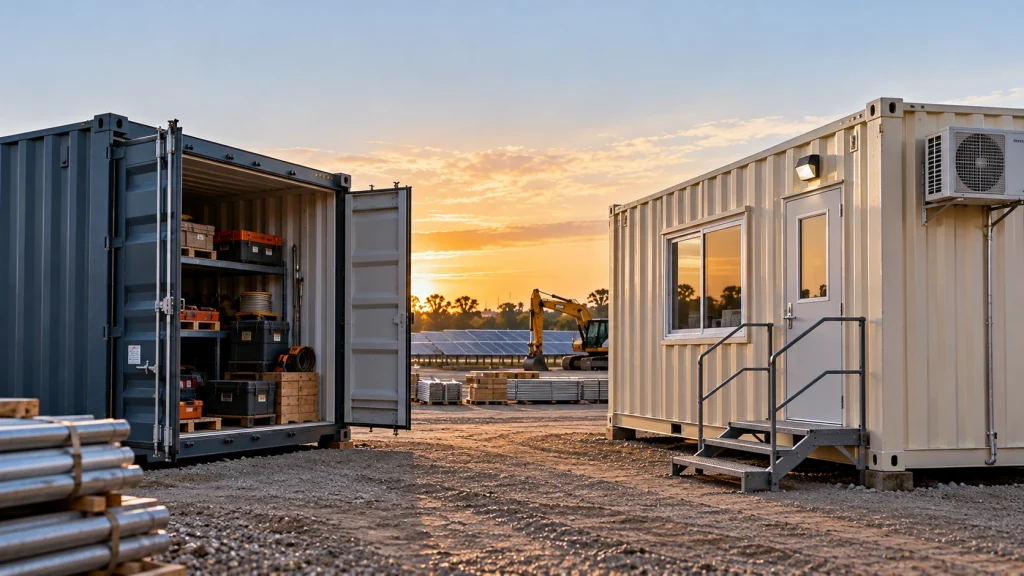
Custom containers start with the same ISO shell and get modified to serve a specific operational function. That can mean insulated walls, finished interiors, HVAC systems, electrical runs, windows, man doors, shelving, or specialized enclosures for equipment like Motor Control Centers. The steel shell is the same. Everything inside is engineered to a use case.
The distinction that matters operationally: a standard container stores things. A custom container houses people, processes, or systems.
That’s not a marketing distinction. It’s a procurement one. If you approach a custom container requirement with the same mental model you’d use for a storage rental, you’ll underbuy on spec and overbuy on frustration.
For context on what different container configurations look like in practice, the portable job site office buildings overview walks through the operational considerations in detail.
When Does a Standard Container Win?
Don’t overcomplicate this. For a significant share of on-site storage needs at construction sites, a standard ISO container is the correct choice.
Consider a typical scenario: a site manager on a solar project in central Louisiana needs secure, ground-level storage for conduit, cable reels, and small tools. The site has flat, accessible ground. No personnel function is involved, and no electrical systems need housing.
A 20-foot or 40-foot container from ManCo’s rental inventory fits that requirement directly. Lockable, weather-resistant, delivered via tilt-bed to a precise position on the active site, with no hidden fees and transparent disclosure of container condition.
Standard containers typically handle straightforward material storage cleanly. Where they lose is at the threshold of function. If someone needs to work inside the unit, or if the unit is housing control systems or electrical distribution equipment, the standard container’s unmodified interior becomes the problem.
That threshold is where the procurement decision actually lives.
Why Do Project Managers Misjudge the Custom Container Decision?
The pattern is consistent. A project manager who has rented storage containers before approaching the custom container decision with the same mental model. They compare square footage and monthly rates. They don’t account for the fact that a custom unit is closer to a prefabricated structure than a storage box, and the cost difference reflects that.
The result is a budget that’s sized for a standard container but a site that needs a finished office or an MCC enclosure. That gap gets closed one of two ways: the project pays for the right solution after the fact, or it operates with the wrong one for the duration of the build.
Waiting to clarify the requirement isn’t a neutral position. Every week the decision stays open, your mobilization window tightens and your options narrow.
The used shipping containers overview covers how condition grading and quality disclosure work in practice, which is relevant when you’re evaluating whether a used custom unit fits your project spec.
A Three-Variable Framework for Making the Right Call
Before the procurement conversation, run through these three variables. They’ll tell you whether you need a standard or custom container before you commit to either.
Function. Is the container housing people, electrical systems, or process controls? If yes, you’re in custom territory. If the container is storing materials or equipment with no personnel or operational systems function, a standard unit is sufficient.
Placement precision. Does the container need to land in a specific position adjacent to other infrastructure, or in a location with access constraints? Both standard and custom units can be placed precisely using tilt-bed or flat-bed delivery. Custom units, though, often have directional requirements such as door orientation and conduit entry points that need to be confirmed before delivery, not during it.
Duration and condition. For projects under 12 months, a rental typically makes more sense than a purchase. For longer deployments, or where the unit is modified to a high specification, the rent-versus-buy calculation shifts. ManCo Rentals & Sales offers both options with no hidden fees and transparent condition disclosure on used units, and the minimum rental period is typically one month.
Use this as a checklist before the procurement conversation, not during it. The time pressure of an active job site is not the right environment to sort out which product category you actually need.
Comparing Your Real Options
The table below isn’t a comparison of container brands. It’s a comparison of what happens when you make a clear, well-matched procurement decision versus what happens when you wait, improvise, or fit the wrong solution to the requirement.
| Factor | Right container, confirmed early with ManCo | Wrong container, improvised or delayed |
|---|---|---|
| Personnel function | Matched to spec before delivery | Crew adapts to an unfinished space |
| Electrical/systems housing | Engineered enclosure, meets site requirements | Standard box, no HVAC or electrical provisions |
| Placement on active site | Confirmed in advance, precision delivery executed | Placement reconsidered on arrival, disrupts site |
| Condition disclosure | Transparent, documented before delivery | Unknown or undisclosed; surprises at return |
| Schedule impact | Container confirmed before mobilization window closes | Procurement revision mid-project, timeline absorbs the cost |
| Weekend delivery | Available through ManCo | Depends entirely on supplier capability |
The comparison that matters most for mid-size construction projects isn’t standard versus custom. It’s the right solution deployed on time versus the wrong solution that costs you schedule.
ManCo Rentals & Sales has been a National Portable Storage Association member since 2007, and that membership reflects a commitment to industry standards that shows up in how containers are graded, disclosed, and delivered. It’s not a ceremonial affiliation. It shows up in the specifics of how each unit leaves the yard.
What Short-Notice Delivery Actually Requires
Short-notice delivery is a claim most suppliers make. Few can execute it on active Gulf Coast job sites.
What it actually requires: confirmed inventory in the right size, a tilt-bed or flat-bed transport vehicle that can reach the site, a driver who can place the unit precisely without disrupting active operations, and a supplier who answers the phone on a Saturday.
ManCo Rentals & Sales offers weekday and weekend delivery, operates out of Eunice, Louisiana, and serves the entire Gulf Coast region including Arkansas and beyond. That geographic footprint is what makes short-notice delivery a real offer rather than a marketing line. Customers who prefer to arrange their own pickup can do so directly at 310 South Bobcat Drive, Eunice, LA 70535.
If your current supplier can’t confirm delivery within your mobilization window, that’s not a logistics inconvenience. It’s a supplier fit problem, and it’s one that typically gets more expensive the longer it stays unsolved.
For a broader look at delivery and logistics considerations across the Gulf Coast, the container transport overview covers the mechanics in detail.
When a Custom Container Isn’t the Right Answer
Custom containers aren’t the right call for every situation. If your storage need is purely material-based with no personnel function and no electrical systems involved, a standard container is the better procurement decision. You’ll spend less, wait less, and get a unit that’s purpose-built for exactly what you need.
If your project timeline is under 60 days and the fabrication lead time for a custom unit exceeds your mobilization window, a standard container deployed immediately outperforms a custom unit that arrives after your crew has already improvised a solution. That calculus is worth running before you start the custom specification process.
The wrong on-site office solution doesn’t fail loudly. It fails slowly, through delay.
If you’re confirming container specifications for an upcoming project, reach out to ManCo Rentals & Sales directly at 877-915-7368 or 337-457-0101. Weekend availability is real. The conversation is straightforward.
Frequently Asked Questions
How quickly can a container be delivered to an active job site in Louisiana?
Standard containers can typically be delivered within days of confirming the order, depending on inventory availability and site access. ManCo Rentals & Sales offers weekday and weekend delivery across Louisiana and the Gulf Coast region. When your mobilization window is tight and you can’t wait until Monday for a callback, that weekend availability is a real operational difference.
What’s the minimum rental period if I only need a container for a short project phase?
The minimum rental period through ManCo Rentals & Sales is typically one month. For project phases shorter than that, a purchase may be worth evaluating. You’d own the unit and could resell or redeploy it rather than paying for time you don’t use.
Can a container be placed precisely on a site that already has equipment and crews working?
Yes, but it requires coordination before delivery, not after. Tilt-bed and flat-bed delivery allows for precise ground-level placement, but the driver needs to know the target position, the access route, and any site constraints in advance. Confirming those details before the delivery date is what makes precision placement work consistently.
What’s included in a custom container, and how do I know what I need?
Custom containers can include insulation, HVAC, electrical runs, finished interior walls and ceilings, windows, man doors, shelving, and specialized enclosures for electrical or control systems. What you need depends on the function. Personnel offices require different specifications than MCC rooms. ManCo works through that with you during the selection process rather than assuming a standard configuration covers the requirement.
Is there a security difference between a standard and a custom container?
Both standard and custom ISO containers are lockable steel enclosures. The security baseline is the same. Custom units may have additional access points such as man doors and windows that need to factor into your site security plan, but the core structure is the same weather-resistant, tamper-resistant shell.
What happens if a container gets damaged on my job site during the rental period?
That’s the right question to ask before you sign, not after. ManCo Rentals & Sales is transparent about container condition at the time of delivery and documents the unit’s state. Damage questions should be addressed directly during the rental agreement conversation so there are no surprises at return.
Can I rent now and convert to a purchase if the project extends?
Yes. ManCo Rentals & Sales offers both rental and purchase options, and the flexibility to convert is worth discussing at the outset. For projects that start as temporary deployments and extend into longer-term site infrastructure, having that option built into the agreement from the start is cleaner than renegotiating mid-project.
If your project is within 90 days of mobilization and your on-site storage and office solution isn’t confirmed yet, that window is shorter than it looks. Contact ManCo Rentals & Sales at 877-915-7368 to confirm availability, discuss container specifications, and lock in delivery timing before your schedule forces the decision for you.
About the Author
Brett Manuel is the President of ManCo Rentals & Sales, LLC, a Louisiana-based provider of ISO shipping containers, portable storage solutions, office containers, and custom container modifications. He oversees the company’s operations across the Gulf Coast, helping commercial, industrial, construction, agricultural, and government clients secure durable container solutions for storage, transportation, and on-site workspace needs. ManCo Rentals & Sales has been a National Portable Storage Association member since 2007 and operates out of Eunice, Louisiana, serving clients throughout the Gulf Coast region and beyond.