Your project site is active, the crew is on the ground, and you still don’t have a functional on-site office. The vendor you contacted last week can’t confirm delivery for another three weeks. That gap isn’t just an inconvenience. It’s real schedule risk on a job where every unresolved day carries a cost.
Key Takeaways
- The right vendor controls the container, the transport, and the delivery coordination directly, without routing anything through a broker
- ManCo Rentals & Sales offers weekday and weekend delivery across Louisiana, Arkansas, and the broader Gulf Coast region using tilt-bed and flat-bed transport
- ISO containers can be moved while loaded, which matters on phased sites where the office location needs to shift as work progresses
- Standard and custom units are both available for rent or purchase, with full upfront condition disclosure on all used containers
- ManCo has been an NPSA member since 2007, meaning container condition standards and delivery practices follow established industry guidelines
What Actually Separates One Vendor from Another?
For project managers running data center builds, AI compute farm installations, or utility-scale solar projects across the Gulf states, the right company for on-site office rentals isn’t the one with the most locations in a directory. It’s the one that can execute your specific delivery, at your specific site, on your actual schedule.
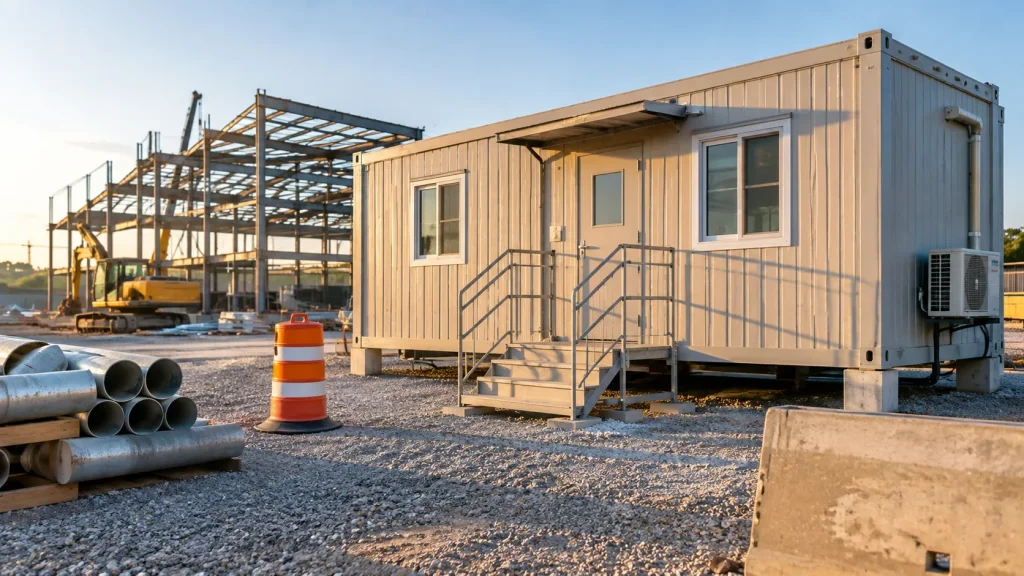
ManCo Rentals & Sales, based in Eunice, Louisiana, delivers 10-foot and 20-foot ISO containers for rent or purchase across Louisiana, Arkansas, and the full Gulf Coast region. The company fabricates and delivers both standard and custom units, handles weekday and weekend delivery, and fully discloses the condition of all used containers before you commit to anything.
That combination matters when your project has active constraints, a tight timeline, or specialized interior requirements that a standard catalog unit won’t satisfy.
Why Do Most Vendor Searches Return the Wrong Results?
Search results for on-site office rentals tend to surface national vendors with regional branch networks. Those vendors are built for volume. They can place a modular unit on a standard timeline to a predictable site. What they generally can’t do is respond to a Tuesday call with a Thursday delivery to a constrained active site, or fabricate a specialized enclosure to your electrical specification from the same yard managing your office unit.
The logistics chain between a national vendor’s inventory and your job site often involves a broker, a subcontracted driver, and a site placement process that wasn’t coordinated with your site manager before the truck left the yard. By the time the unit arrives, the specific placement details you assumed were communicated have a way of not having traveled at all.
For a detailed look at how to vet vendors before you sign anything, the guide to evaluating container rental providers covers exactly what to ask and what the answers should tell you.
When Does a Regional Specialist Become the Only Workable Option?
Not every project requires a vendor with fabrication capability and direct delivery control. A standard unit from a national vendor on a two-week lead time is reasonable when your requirements are simple and your schedule has some room built in.
The calculation shifts when several of the following conditions are active at once:
- Short-notice delivery requirement, meaning less than two weeks from first contact to placement
- An active site with constrained access or precise placement requirements
- A multi-phase project where the office location will need to shift as work progresses
- Specialized interior requirements including HVAC, electrical, finished walls, or dedicated control room configurations
- Multi-site deployment with a preference for a single coordinating vendor across the full footprint
When those conditions stack up, a regional provider with direct fabrication and delivery capability isn’t just a preference. It’s the only option that can actually execute.
If you’re working through the standard-versus-custom question before your site goes live, the ISO container sales vs. rental decision guide lays out the practical tradeoffs clearly.
What Does Short-Notice Delivery Actually Require?
Short-notice delivery to an active construction site isn’t purely a logistics question. It’s a site coordination question. The driver needs to know the access route, the ground conditions, the placement target, and any overhead clearance issues before the truck rolls. That information has to travel from your site manager to the delivery crew in advance, not during the drop itself.
When you call ManCo, you’re talking to the same operation that owns the container and controls the transport. There’s no broker relaying your site specifications through a chain that adds time and loses detail at every handoff. Delivery uses tilt-bed or flat-bed transport, coordinated directly with your team before departure.
Consider a typical scenario on an active solar build: the site manager needs the office unit placed within a specific section of the site because the crew is working that area for the next several weeks. That’s not a standard drop-and-go request. It requires a driver who arrived knowing the placement requirement and a vendor who communicated it clearly before the truck left the yard. When the delivery chain has more links in it, that level of coordination becomes unreliable in direct proportion to its length.
Ask any vendor directly: who controls the final placement decision on the day of delivery? The answer will tell you a great deal about how the rest of the relationship will go.
Standard vs. Custom: Which Does Your Project Actually Need?
A standard 10-foot or 20-foot ISO container covers a wide range of project needs. If you need a lockable, weatherproof space for documents, tools, or basic site operations, a standard unit delivered promptly solves the problem without requiring a spec sheet or a fabrication lead time.
Custom units are a different conversation. Fabrication adds insulation, finished interiors, windows, dedicated entry doors, HVAC, electrical, and in some cases specialized enclosures for equipment control systems. The lead time for a custom build is real, and it runs ahead of your mobilization date. It doesn’t compress to fit around a start date that’s already been confirmed.
The practical implication: if your project needs a custom unit and you’re two weeks from site activation, the time to start the conversation is now. Fabrication has a minimum timeline regardless of how urgent your schedule feels.
For projects that need multiple unit types across a large footprint, coordinating everything through a single vendor avoids the multi-party logistics problem of sourcing office units from one supplier, storage from another, and specialized enclosures from a third. ManCo handles the full range, from standard rentals to custom container configurations, through the same direct operation.
The portable office buildings comparison guide also walks through how Gulf Coast project managers think through this decision in practical terms.
What Do Project Managers on Gulf Coast Sites Most Often Get Wrong?
The most common mistake isn’t choosing the wrong vendor. It’s waiting too long to choose any vendor.
The decision gets deferred because the site activation date feels far enough out, and by the time it becomes urgent, every remaining option has a catch. The national vendor can deliver in three weeks. The regional vendor with fabrication capacity has one unit left in the configuration needed. The project starts without a functional office, and the site manager runs operations from a truck cab for the first two weeks.
That delay doesn’t show up as a line item anywhere. It shows up in coordination failures, documentation gaps, and safety briefings held in whatever space happens to be available. The wrong on-site office solution doesn’t fail loudly. It fails quietly, through accumulating friction.
ManCo has been a member of the National Portable Storage Association since 2007. That membership means the company operates under established industry standards for container condition disclosure and delivery practices. When a used container is described as being in a specific condition, that disclosure follows a recognized standard, not an informal courtesy at the vendor’s discretion.
If flexible rental terms and contract structure matter on your project, the shipping container rental terms guide for Louisiana businesses covers what to review before committing.
Comparing Your Options: Acting Now vs. Waiting
| Factor | Working with ManCo Rentals & Sales | Waiting or routing through a national broker |
|---|---|---|
| Delivery timeline | Weekday and weekend, direct transport coordinated with your site | Undefined; depends on branch availability and subcontractor scheduling |
| Placement coordination | Handled directly with your site manager before the truck leaves | Standard drop; precise placement not guaranteed in advance |
| Custom fabrication | Available, built and delivered from the same operation | Often brokered or unavailable on short notice |
| Condition transparency | Full upfront disclosure on all used units before you commit | Varies; condition sometimes confirmed only after arrival |
| Coverage area | Louisiana, Arkansas, and the Gulf Coast region | National footprint with variable regional depth |
| Single-vendor coordination | Office, storage, and specialized enclosures through one contact | Multiple vendors, multiple coordination points, multiple failure opportunities |
The cost of waiting isn’t the rental rate. It’s the project days lost while the office situation is still unresolved.
A Note on Fit: When This Works and When It Needs a Conversation First
ManCo works best for direct, ground-level container delivery to accessible sites across the Gulf Coast region. There are situations where the logistics need a conversation before a booking is confirmed.
If your site has physical access restrictions, low overhead clearance, soft ground that can’t support a loaded container, or other conditions that affect tilt-bed delivery, those specifics need to be worked through before a delivery date is set. ManCo will have that conversation directly and tell you what’s workable before anything is committed. If a site isn’t serviceable, you’ll hear that clearly rather than finding out when the truck is already at the gate.
For projects outside the Gulf Coast service region, contact ManCo directly to confirm coverage before assuming availability.
Frequently Asked Questions
How quickly can ManCo deliver a container office to a Gulf Coast job site?
Delivery timelines depend on site location and unit availability. ManCo offers weekday and weekend delivery across Louisiana, Arkansas, and the Gulf Coast region. The most accurate answer comes from calling with your site address, placement requirements, and target date well before the project starts.
Can the container office be relocated once it’s placed on site?
Yes. ISO containers can be moved while loaded, which makes them practical for phased construction sites where the office location needs to shift as work progresses. Coordinate any relocation with ManCo the same way you’d coordinate the initial delivery.
What’s the difference between a standard container and a custom-built unit?
A standard container is a lockable, weather-resistant ISO unit with no interior modifications. A custom unit includes fabricated interiors such as insulation, finished walls, HVAC, electrical, and windows, along with specialized configurations for equipment control or other operational requirements. Lead time on custom units is longer, so the spec and quote process should start well before mobilization.
Does ManCo disclose the condition of used containers before delivery?
Yes. ManCo fully discloses the condition of all used containers before you commit, so there are no surprises when the unit arrives. This isn’t an exception made case by case. It’s a standard practice, and it’s part of what NPSA membership means in a practical context.
Can ManCo handle a multi-site deployment across the Gulf Coast?
Yes. ManCo serves the Gulf Coast region directly and handles multi-site projects through the same direct operation, without routing coordination through third-party brokers. Confirm site locations and scheduling requirements when you request a quote.
What container sizes are available for on-site office rentals?
ManCo offers 10-foot and 20-foot ISO containers for rent and purchase. Custom configurations are built to spec based on project requirements and should be requested as early as possible in the planning timeline.
How do I know whether a custom unit or a standard container is the right call for my project?
If your requirement is a secure, weatherproof space for documents, tools, or basic site operations, a standard unit is likely sufficient. If you need HVAC, electrical, finished interiors, or a specialized enclosure for equipment control systems, you need a custom build. The custom vs. standard container decision framework covers this in practical detail.
Your project’s schedule doesn’t pause while the office situation gets sorted out. If you’re planning a data center build, solar installation, or AI compute farm deployment across the Gulf states and need a container office delivered on a real schedule to a real site, contact ManCo Rentals & Sales directly. Describe your site, your timeline, and your requirements. You’ll get a straight answer on what’s available and when it can be there.
Visit the rentals page or reach out to the Eunice, Louisiana team to confirm availability for your project.
About the Author
Brett Manuel is the President of ManCo Rentals & Sales, LLC, a Louisiana-based provider of ISO shipping containers, portable storage solutions, office containers, and custom container modifications. He oversees the company’s operations across the Gulf Coast, helping commercial, industrial, construction, agricultural, and government clients secure durable container solutions for storage, transportation, and on-site workspace needs. ManCo Rentals & Sales has been an NPSA member since 2007 and serves clients across Louisiana, Arkansas, and the broader Gulf Coast region.