Choosing between a standard ISO container and a custom-built unit isn’t about size, and it’s rarely about budget. It’s about function. Order the wrong category and you won’t know until the unit is already on your site, your subcontractors are already mobilized, and reordering costs time you don’t have.
Key Takeaways
- Standard ISO containers are the right fit for secure, ground-level storage where no personnel work inside and no specialized systems are housed there
- Custom containers are a distinct product category built for specific operational functions, not a premium version of a standard unit
- The real cost comparison is between the right unit and the wrong one already on site, not between a standard and a custom monthly rate
- Confirming your use-case requirements before ordering is the single step that prevents a mismatched unit from arriving at your job site
- Short-notice delivery and precise on-site placement require a supplier with direct transport capability, not a brokered third party
What Is the Actual Decision Here?
Two things determine which container category fits your project. First, what the unit needs to do. Second, what happens to your project if it can’t do that reliably.
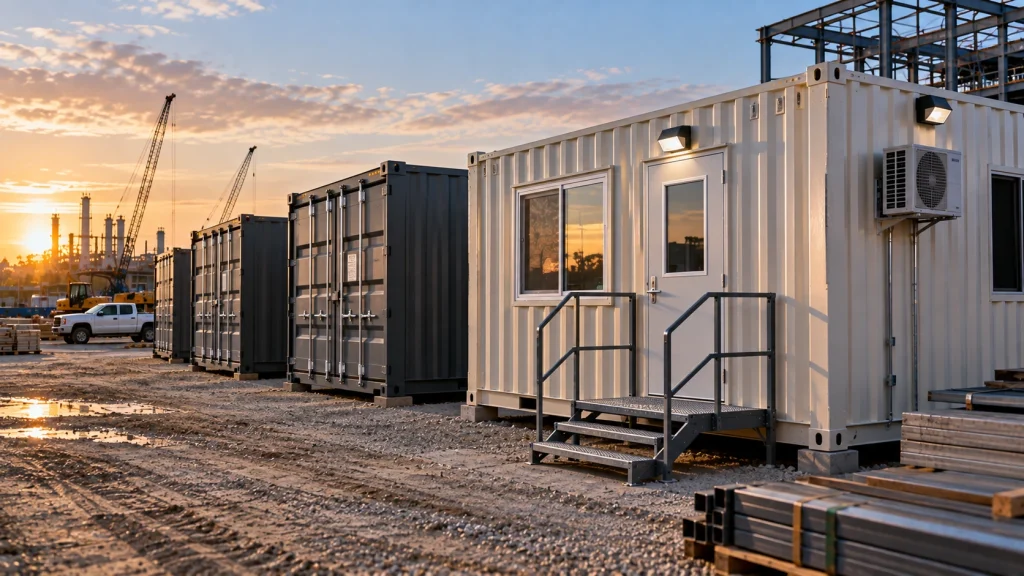
A standard 20-foot ISO container is a lockable, weather-resistant steel enclosure. That’s exactly the right tool for tool storage, material staging, and secure equipment holding on an active site. It’s not the right tool when a site supervisor needs a climate-controlled workspace, or when electrical distribution systems require a purpose-built enclosure designed to meet industrial safety requirements.
The category you choose defines the operational capability you’re deploying. Size is one variable. Function determines whether the unit does the job at all. ManCo’s rental and sales options cover both categories, with weekday and weekend delivery across Louisiana and the Gulf Coast.
Why Do Projects End Up With the Wrong Container?
It’s usually not a budget problem. It’s a category confusion problem.
Standard containers and custom containers often appear on the same sourcing sheets, described in overlapping language, formatted in similar columns. That creates a false equivalence. A project manager working under deadline sees the word “container” and selects the lower-cost line item. Then the site supervisor arrives expecting a working office. Or the electrical contractor shows up needing a Motor Control Center room, which is a purpose-built enclosure designed to house electrical control and distribution systems for heavy industrial equipment.
The unit that looked acceptable in the procurement column becomes a site problem before the end of the first week.
Here’s why that failure happens. Procurement decisions made at the line-item level don’t capture functional requirements that live in a different department’s scope. The purchasing manager sees a container rental line item. The site manager sees a workspace or an equipment enclosure. When those two people aren’t coordinating before the order is placed, the wrong unit ships.
There’s also a timing problem. A custom unit built to specification requires a fabrication lead time that has to be confirmed at the scoping stage, not after the electrical subcontractor has already mobilized. Ordering it once the need is urgent means the project waits. That’s a sequencing problem that starts at procurement, not a supplier problem.
When Each Option Is the Right Call
Before committing to either category, answer three questions about what the unit needs to do on your specific site.
First, will personnel work inside it regularly? Second, does it need to house electrical, mechanical, or control systems? Third, does the environment require climate control or purpose-built ventilation?
If all three answers are no, a standard ISO container is the correct choice. It’s durable, lockable, and available for short-notice delivery. ManCo offers 10-foot, 20-foot, and 40-foot ISO containers, with condition confirmed before any order is finalized. For a closer look at how standard containers address on-site storage requirements, that resource walks through the practical fit criteria worth reviewing before you commit.
If any one of those three questions gets a yes, you’re in custom container territory. Not because standard containers are inferior products, but because they were never built for those functions. Custom units can include fully finished interiors, insulation, HVAC systems, windows, doors, electrical panel provisions, and purpose-specific floor plans configured to the actual use case.
The table below shows where the real cost exposure lives. The expensive mistake isn’t choosing custom when you needed standard. It’s choosing standard when you needed custom, because you don’t find out until the unit is already on your site.
| Decision Factor | Confirming Fit With ManCo Before Ordering | Ordering Without Confirming Use-Case First |
|---|---|---|
| Function match | Confirmed before delivery | Assumed at order stage |
| Personnel workspace inside | Available when custom unit is specified | Not supported by a standard container |
| Electrical system housing | Available through custom-built unit | Not appropriate for standard containers |
| Delivery placement | Direct transport, site-specific positioning | General drop, second trip likely required |
| Cost exposure | Transparent, no hidden fees | Unit on site, unusable, rescheduling required |
| Multi-site coordination | Managed through a single supplier | Split across multiple vendors |
| Lead time for custom builds | Confirmed at scoping stage | May not align with mobilization schedule |
What Happens When Delivery Goes Wrong?
Getting the right container is half the equation. Getting it placed correctly on an active job site is the other half.
Active construction sites, data center builds, and energy projects all carry specific placement requirements. Low clearances, soft ground, equipment staging zones, and active site traffic affect where a container can go and how it gets there. A supplier that brokers delivery through a third party can confirm the unit arrives somewhere on the property. They can’t confirm it lands where the site actually needs it.
ManCo coordinates delivery directly using tilt-bed or flat-bed transport, or works with customers who prefer to arrange their own pickup. That direct capability allows for controlled, site-specific placement. It matters when the container needs to land in a precise position relative to other infrastructure, and it matters when the window is tight and there’s no room for a second delivery attempt. Getting container placement right on the first trip starts with a supplier who controls the last mile, not just the order.
Weekend delivery is available. ManCo delivers directly across Louisiana, the Gulf Coast, Arkansas, and the surrounding region.
A Straight Position on Custom Containers
Here’s something most container suppliers won’t say directly: custom containers are sometimes recommended to customers who don’t actually need them.
A fully finished, climate-controlled office container is a real investment. If the project runs six months and the unit mostly sits unoccupied, you’ve paid for capability that didn’t earn its cost. Standard containers are genuinely solid products for the right application.
But the honest position cuts just as hard in the other direction. Standard containers are regularly ordered by customers who actually needed custom units, because the lower monthly rate looks better in a budget column.
Consider a situation where a site supervisor has no conditioned workspace on a Gulf Coast job site in the middle of summer. The storage container they’ve been assigned has no ventilation and no climate control. Interior temperatures could reach the point where the space becomes unusable by mid-morning, which would mean personnel effectively working out of a vehicle for most of the day. That’s not a minor inconvenience on a project running a compressed schedule. It’s a productivity and safety problem that compounds every day it isn’t resolved.
The wrong on-site office solution doesn’t fail loudly. It fails slowly, through delay, through workarounds, through decisions made without the information or space to make them properly.
The real cost calculation isn’t the monthly rate. It’s the monthly rate plus the operational cost of the function the unit can’t perform.
ManCo works through a use-case confirmation process before any order is finalized. That’s not a sales step. It’s how you avoid paying for a unit that can’t do the job. ManCo has been a National Portable Storage Association member since 2007, and that tenure in portable storage reflects practical, accumulated understanding of where these decisions go wrong. For more context on how container selection affects project outcomes, that resource is worth reviewing early in the scoping process.
Multi-Site Deployments and What They Require From a Supplier
For projects requiring custom-built units engineered to specification and delivered across multiple sites on a demanding schedule, fabrication and logistics become the deciding factors in supplier selection.
ManCo recently served as the named sole supplier for a multi-state frac sand mining operation, fabricating and deploying custom units across Louisiana and Texas. The scope covered three categories: job site offices, operational control rooms, and Motor Control Center rooms built to house electrical control and distribution systems for heavy industrial equipment. Units were staged and delivered on a coordinated schedule, with ManCo carrying full supplier responsibility across both states.
That kind of deployment requires a supplier who can build, stage, and deliver without a third party in the chain. The portable job site office infrastructure overview covers the same direct-delivery approach applied to demanding site conditions, and is worth reviewing if your project involves personnel facilities at scale.
If you’re evaluating used containers for storage applications, the condition factors worth confirming on used units covers what to verify before committing. For available inventory and current rental terms, the ManCo rentals page covers what’s in stock and how the process works.
Ready to confirm the right container for your site? Contact ManCo Rentals & Sales at 877-915-7368 or 337-457-0101.
Frequently Asked Questions
How do I know whether my project needs a standard or custom container?
Answer three questions before ordering: will personnel work inside it regularly, does it need to house electrical or mechanical systems, and does the environment require climate control? If any answer is yes, you need a custom unit. If all three are no, a standard ISO container fits the requirement. Confirming those answers before the order is placed is the step that prevents the wrong unit from arriving on site.
What’s included in a custom container build?
Custom units are built to the requirements of the specific use case, so the scope varies by project. Finished interior walls, insulation, HVAC, electrical panel provisions, windows, and doors are all configurable. ManCo confirms the full build scope before quoting so there are no surprises on delivery or final cost.
Can I rent month to month, or is a long-term commitment required?
The minimum rental period is typically one month. For construction, data center, and energy project timelines that shift frequently, that flexibility matters. ManCo charges no hidden fees on rentals, and all terms are confirmed upfront before delivery.
What’s the actual difference between a job site office container and a standard container with a cut-in door?
A job site office container is built for occupancy: finished interior walls, climate control, lighting, and electrical outlets designed for regular personnel use. A standard container with a modified opening is still a steel box without conditioning or finished surfaces. The difference shows up in temperature, air quality, and whether the people inside can work effectively during Gulf Coast conditions. Those aren’t cosmetic differences on a project with personnel on site all day.
How does precise placement work on an active site?
Direct transport using tilt-bed or flat-bed equipment allows for controlled placement rather than a general drop. Before scheduling delivery, confirm the target position, any overhead clearances, and ground conditions at the placement point. Providing those details to ManCo before the truck is dispatched is how the container lands where it needs to go on the first trip.
Is a used container a legitimate option for a professional job site?
Used containers are a solid choice for storage applications where appearance isn’t the priority. ManCo works through a condition confirmation process so customers understand exactly what they’re receiving before delivery. For client-facing spaces or personnel offices, a new or custom unit is the appropriate choice. For tool storage and material staging, a quality used container performs the same function without paying for finish you don’t need.
What if my project spans multiple sites across different states?
ManCo has direct delivery capability across Louisiana, the Gulf Coast, Arkansas, and beyond. For multi-site deployments, the process involves confirming access conditions at each location and sequencing delivery around the project schedule. The frac sand mining deployment referenced in this article, covering multiple unit types across Louisiana and Texas, reflects how ManCo manages multi-site projects as a sole supplier.
Brett Manuel is the President of ManCo Rentals & Sales, LLC, a Louisiana-based provider of ISO shipping containers, portable storage solutions, office containers, and custom container modifications. ManCo Rentals & Sales is located at 310 South Bobcat Drive, Eunice, LA 70535, and has served the Gulf Coast region as a National Portable Storage Association member since 2007. Reach them at 877-915-7368 or 337-457-0101.