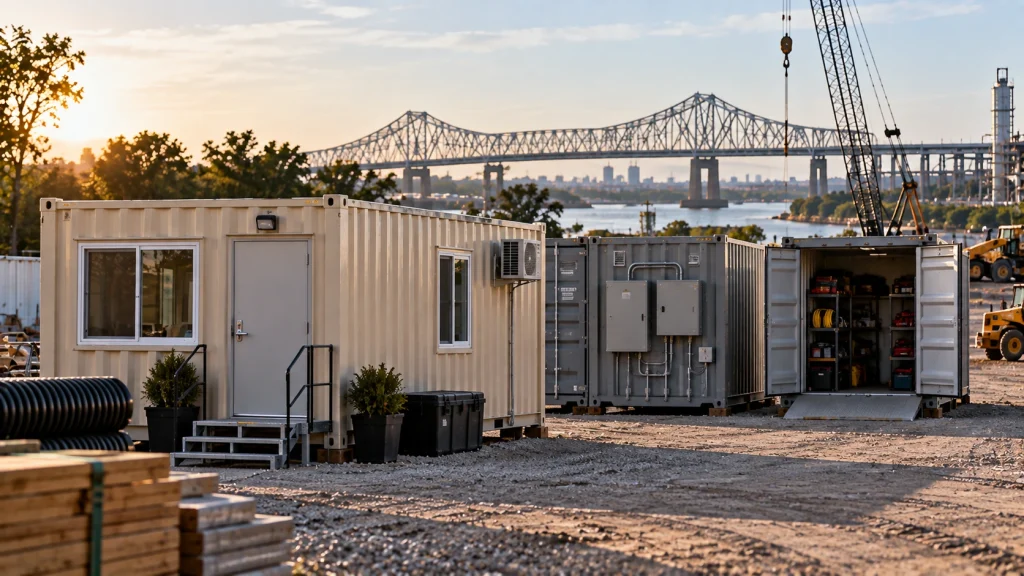
Custom shipping container rentals follow a specific sequence: identify the right container type, confirm site conditions, choose between standard and custom configuration, agree on terms, and coordinate delivery. Get that sequence right and you have a ground-level, lockable, field-ready unit placed exactly where you need it. Get it wrong and you have a box that doesn’t fit the work.
Key Takeaways
- Standard ISO containers handle secure on-site storage; custom builds handle job site offices, control rooms, and electrical housing, each with different functional requirements
- Site conditions determine delivery method before any other detail gets confirmed
- ManCo Rentals & Sales delivers weekday and weekend across the Gulf Coast, Louisiana, Texas, Arkansas, and beyond
- Minimum rental period is typically one month, which keeps short-notice deployments financially practical
- ManCo has been an NPSA member since 2007 and operates with transparent condition disclosures and no hidden rental fees
Why Does Container Procurement Go Wrong Before the Truck Even Leaves the Yard?
The most common mistake isn’t picking the wrong size. It’s treating the container as a detail to settle after the real planning is done.
Picture a project manager on a mid-size construction site in Louisiana who scopes storage and site office needs late in mobilization planning. By the time someone calls about a rental, the site is already active, the schedule is compressed, and there’s no margin for a second delivery run. That’s not a standard procurement failure. It’s a sequencing failure. The container decision got made after everything else locked in, which means delivery logistics, placement constraints, and build-out requirements all got discovered under pressure instead of planned for.
The fix isn’t complicated. Treat the container decision the way you treat equipment rentals: scope it early, confirm site access, and know whether you need a standard unit or a custom build before you’re three weeks into mobilization.
What makes that sequencing matter is what happens when you ignore it. A unit that doesn’t fit the functional requirement creates daily friction that compounds quietly. The crew that needs climate-controlled workspace gets a standard box with no interior finish. The electrical distribution equipment that needs a ventilated enclosure ends up in a space not built for it. Neither failure announces itself loudly on day one. Both show up in slow delay, rework, and workaround.
What’s the Real Difference Between a Standard and a Custom Container?
A standard ISO container is a steel, weather-resistant enclosure in 10-foot, 20-foot, or 40-foot lengths. It locks. It keeps water out. It sits on the ground. There’s no interior finish, no climate control, no built-out workspace. It’s designed for secure storage of materials, tools, and inventory, and it does that job well.
A custom container is a different category entirely.
It starts with a standard ISO unit and gets modified before delivery to serve a specific operational role. That can mean insulation and HVAC for a job site office, interior wall finishes and lighting for a personnel workspace, electrical rough-in for an equipment housing enclosure, or exterior access panels and ventilation for a Motor Control Center (MCC) room. An MCC room is a specialized enclosure designed to house electrical control and distribution systems for heavy industrial equipment. It isn’t a storage unit with some wiring added. It’s engineered to a specific functional specification.
These two products solve different problems. Conflating them creates procurement errors that cost more to correct than they would have cost to avoid from the start.
Consider a typical multi-function site: a project needs secure storage for materials, a climate-controlled space where engineers can review drawings and hold meetings, and a protected enclosure for electrical control systems. Ordering one standard container and expecting it to serve all three functions creates a cascade of compromises. Ordering the right unit for each function costs more upfront and avoids far larger downstream costs.
If you’re working through ManCo’s rental options for the first time, that distinction between standard and custom is the first decision worth getting right before anything else gets confirmed.
How Does the Custom Build Process Actually Work?
ManCo Rentals & Sales works through a specific sequence, and each step exists because skipping it creates a problem further down the line.
Define the functional requirement first. Not “we need a container” but “we need a space that does X for Y people or houses Y equipment.” A four-person job site office requires different specs than an enclosure housing electrical distribution systems. The functional requirement drives every downstream decision about size, configuration, and build-out scope.
Confirm site conditions before anything else gets scheduled. Tilt-bed and flat-bed delivery have different clearance and access requirements. An active job site with overhead lines, soft ground, or restricted entry points changes the delivery approach before it changes anything else. You need to know your site constraints before that conversation starts, not during it.
Choose size and configuration. ManCo offers 10-foot, 20-foot, and 40-foot ISO containers. The right size isn’t always the largest available. A 10-foot custom office unit placed precisely on a constrained site does more useful work than a 40-foot unit that can’t be positioned where the crew actually operates.
Confirm rental or purchase terms. Rentals carry a minimum period of typically one month, with no hidden fees. Payment by major credit card, debit card, or bank transfer. ManCo offers both new and used containers with full condition disclosure on both, so you’re not guessing about what you’re getting.
Schedule delivery. ManCo delivers weekday and weekend across the Gulf Coast region, from Louisiana into Texas, Arkansas, and beyond. For active job sites, weekend delivery means the unit is placed and ready before Monday’s crew arrives without consuming a production day.
Which Container Type Fits Which Site Role?
Assign a function first. The container type follows from that.
| Site Function | What It Actually Requires | Container Type | Typical Configuration |
|---|---|---|---|
| Material and tool storage | Secure, weatherproof, lockable | Standard ISO container | 20-foot or 40-foot, no interior finish needed |
| Personnel workspace | Climate control, lighting, surfaces for working | Custom office build | 10-foot or 20-foot with insulation, HVAC, windows |
| Electrical equipment housing | Ventilation, electrical clearance, access panels | Custom MCC or control room build | 20-foot, engineered to electrical and operational spec |
| Combined storage and light office use | Divided interior with separate functions | Custom partition build | 20-foot with interior divider and basic office finish |
This table isn’t a product menu. It’s a forcing function. If you can’t name the function in the left column, you can’t confirm the right container in the right column. Projects that skip that step end up retrofitting or re-delivering, and both options cost more than getting it right once.
What Does Delivery to an Active Job Site Actually Require?
Delivery is where container projects fail most often, and it gets the least planning attention during procurement.
Precise placement on an active job site isn’t a logistics convenience. It’s a site safety and operational efficiency requirement. A container placed in the wrong location or orientation compounds into a workflow problem that doesn’t resolve itself on its own.
The mechanism behind a clean delivery is straightforward: the driver needs to know the site before arrival, not on arrival. Ground conditions, overhead clearances, access point restrictions, and exact placement requirements all need to be communicated during scheduling. ManCo uses tilt-bed or flat-bed transport depending on site conditions, and that decision gets made during the scheduling conversation, not at the gate when the truck is already there.
For controlled-access sites, including data center builds, industrial installations, and infrastructure projects where site entry is sequenced, coordinating the delivery within an existing logistics window matters. The portable job site office planning guide is worth reading if you want a clearer picture of what a well-scoped delivery and placement process looks like before you confirm your own. You can also review how ManCo approaches data center site support for a sense of what coordinated delivery looks like on a controlled-access site with specific placement requirements.
What Happens When You Wait or Wing It?
Some project managers treat container procurement as something to sort out once everything else is moving. That approach is more expensive than it looks.
| Situation | Acting Early With ManCo | Waiting, Improvising, or Using an Unqualified Supplier |
|---|---|---|
| Unit fit for purpose | Confirmed before delivery | Discovered on arrival, sometimes wrong |
| Delivery coordination | Scheduled around site access | Reactive, often causes production delays |
| Custom build lead time | Built into mobilization schedule | Compressed or impossible to accommodate |
| Condition transparency | Full disclosure on new and used inventory | Varies; condition surprises happen after delivery |
| Site access complications | Resolved during scheduling conversation | Discovered when the truck is at the gate |
| Cost of correction | Avoided through upfront planning | Higher than the original procurement cost |
The cost of acting with a qualified supplier is visible. The cost of not acting, or acting too late, shows up in ways that don’t appear on a single line item: lost production time, re-delivery fees, crew working in spaces that weren’t built for the actual task.
When Does a Custom Container Rental Not Make Sense?
This question deserves a straight answer.
If your site is physically inaccessible due to terrain, low overhead clearances, or entry restrictions that can’t accommodate tilt-bed or flat-bed transport, the right move is to resolve that access problem before ordering a container. Trying to force a delivery into a site that hasn’t been cleared for it creates a different and more expensive problem.
Custom builds also require lead time because modifications are completed before delivery, not after the unit arrives on site. If you need something on site in 72 hours, a standard unit is the practical answer. ManCo can often accommodate that timeline for standard inventory. A custom build can’t be compressed without compromising the spec, and a compromised spec defeats the reason for ordering a custom unit in the first place.
If you’re weighing a purchase rather than a rental and want to understand what transparent condition disclosure actually looks like in practice, the guide to evaluating quality in used containers covers the condition evaluation process in real terms.
For a broader look at how storage container options break down across Louisiana project types, the storage solutions overview is a useful starting point.
FAQ
How far in advance should I order a custom container for a construction project?
For a standard container rental, lead time can be as short as a few days depending on inventory and delivery scheduling. Custom builds require more lead time because modifications are finished before the unit ships. The earlier you confirm your functional requirements and site conditions, the more configuration options stay open. Calling with two weeks of runway is better than calling with two days.
Can I rent a container for just one month if my project timeline is short?
Yes. ManCo’s minimum rental period is typically one month, which makes short-notice deployments on compressed project timelines financially practical without committing to a long-term arrangement.
What sizes are available for on-site office container rentals?
ManCo offers 10-foot, 20-foot, and 40-foot ISO containers. For office configurations, 10-foot and 20-foot units are the most common because they’re easier to place precisely on active job sites while still providing functional workspace for personnel.
Does ManCo fully disclose the condition of used containers?
Yes. ManCo fully discloses the condition of both new and used inventory. Pricing reflects actual condition. The company doesn’t represent used units as new or obscure wear that affects how a unit performs. If budget is a factor, a used standard container often covers basic storage requirements without compromising the core function.
Can ManCo deliver to states outside Louisiana?
Yes. ManCo serves the entire Gulf Coast region, including Texas, Arkansas, and nearby Gulf states. Both weekday and weekend delivery are available. Delivery is coordinated directly by ManCo, not brokered through a third party.
What if my site conditions change after I’ve confirmed a delivery?
Contact ManCo as early as possible. Site condition changes that affect delivery method or placement, such as new overhead obstructions or revised access restrictions, need to be communicated before the truck is dispatched. The earlier that conversation happens, the more options exist for adjusting the approach without delaying the deployment.
How do I know whether I need a standard container or a custom build?
If the container will house people, operational equipment, or electrical systems, a custom build is the right answer. If it’s storing materials, tools, or inventory in a controlled environment, a standard container does the job. The functional requirement answers the question. The container type follows from that answer, not the other way around.
The wrong container decision doesn’t announce itself on day one. It shows up in small frictions: the crew with no functional workspace, the equipment without a proper enclosure, the site visit that can’t happen because there’s nowhere to hold it. Spec the container the same way you spec everything else that has to perform on your project.
ManCo Rentals & Sales, LLC is located at 310 South Bobcat Drive, Eunice, LA 70535. Reach the team at 877-915-7368 or 337-457-0101. NPSA member since 2007. Weekday and weekend delivery available across the Gulf Coast region. No hidden fees on rentals.
Contact ManCo directly to confirm what’s available for your site and get your delivery scheduled before your mobilization window closes.
About the Author
Brett Manuel is the President of ManCo Rentals & Sales, LLC, a Louisiana-based provider of ISO shipping containers, portable storage solutions, office containers, and custom container modifications. He oversees the company’s operations across the Gulf Coast, working directly with commercial, industrial, construction, and energy clients on container solutions for storage and on-site workspace. ManCo Rentals & Sales has been a member of the National Portable Storage Association since 2007.