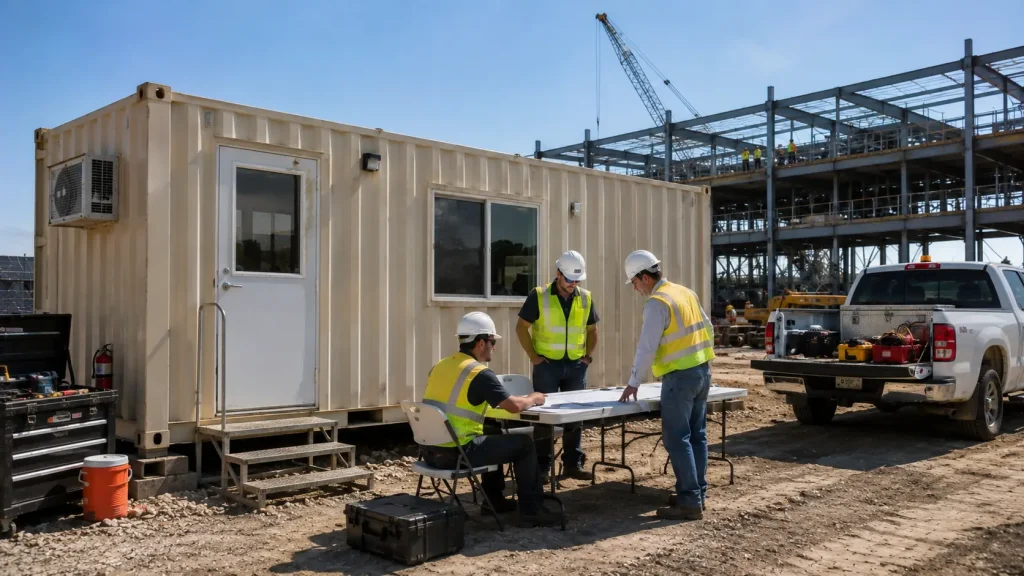
Your site goes active on a fixed date. The crew shows up whether the workspace is ready or not. Getting the spec wrong on on-site office space doesn’t announce itself as a procurement failure. It shows up as lost days, crew friction, and project decisions getting made in conditions that weren’t designed for the work inside them.
Key Takeaways
- Custom ISO containers can be configured as job site offices, control rooms, or specialized electrical enclosures, built to your spec and delivered to active Gulf Coast sites without a prepared foundation
- Standard containers handle secure storage reliably; custom containers are built for people working in Gulf Coast field conditions
- ManCo provides weekday and weekend delivery with full condition disclosure before any unit ships, and no hidden fees
- Modular buildings suit permanent, permitted installs better; containers are the stronger call when your timeline is compressed and your site is already active
- The minimum rental period is typically one month, making containers a practical fit for short-duration project phases
What Actually Goes Wrong When You Choose the Wrong On-Site Office Solution?
The surface problem looks simple: you need workspace on site before mobilization. The real problem is that the wrong solution generates its own complications while your project clock keeps moving.
Modular buildings require permits, prepared foundations, and utility hookups before anyone works inside one. Prefab trailers are faster, but most weren’t designed for the heat cycles, humidity, and storm exposure that define Gulf Coast conditions across a full project phase. Temporary shade structures don’t address anything beyond temperature, and they solve none of the operational requirements for a functioning workspace.
The failure mode isn’t usually a defective unit. It’s a mismatch between what was ordered and what the site actually requires. A workspace that performs adequately in a stable climate with reliable utility access is a different product from what you need on an active industrial site in Louisiana in July. When you treat procurement as a cost-per-month decision, you’re measuring the wrong variable. The variable that matters is total time from order to fully operational, which includes delivery lead time, any site preparation the solution demands, utility connections, and productive hours your crew loses while waiting.
Getting the spec wrong is how projects lose days they don’t recover.
Why Do ISO Containers Work So Well on Active Industrial Sites?
The answer is structural, not marketing. ISO containers are built around a continuous corner-post and cross-member system that lets the unit sit on grade without a poured foundation, hold its shape through a Gulf Coast summer without racking, and resist the moisture and heat cycles that degrade lighter structures over time.
That’s the same structural design that makes containers stackable at port under full load. On an active job site, it means the unit can be placed on a level, compacted surface and be operational the same day it arrives. No pad. No pre-work beyond what you choose to add. That’s not a convenience feature. It’s an engineering characteristic with direct consequences for your deployment window.
ManCo’s container rental options are available across the Gulf Coast region, including Louisiana, Texas, Mississippi, and beyond, with weekday and weekend delivery coordinated directly with each customer. Units are available in 10-foot, 20-foot, and 40-foot sizes. Which one you choose has real consequences for how it fits against an active site plan, and reviewing how to select the right container dimensions for your project before confirming a configuration is worth the time when your site plan is already locked.
How Do the Real Alternatives Compare?
Two variables do most of the sorting: how quickly you need the unit operational, and how long it’ll be on site.
| Approach | Site Prep Required | Gulf Coast Durability | Best Fit | What Waiting or the Wrong Call Costs |
| Custom ISO Container (ManCo) | Minimal, level surface only | High, ISO-rated steel, weather-sealed | Active sites, compressed timelines, specific operational requirements | Spec delays compress your deployment window when decisions slip late |
| Standard ISO Container (ManCo) | Minimal | High | Secure on-site storage | Right for storage, not a substitute for a configured workspace |
| Modular Building | Significant, pad and utilities required | High for permanent installs | Projects over two years with a stable, permitted footprint | Delayed mobilization if site conditions aren’t ready at delivery |
| Prefab Trailer | Low to moderate | Moderate | Short-term use in mild, stable conditions | Durability risk compounds in Gulf Coast heat and humidity across a long phase |
| Waiting on procurement | None | None | Nothing | Every day a phase start slips is a day you don’t recover |
If you need something operational quickly on an active site in Louisiana, Mississippi, or Texas, the choice narrows to containers and trailers. Containers hold the advantage on site prep requirements, Gulf Coast durability, and the depth of customization available. Waiting isn’t a neutral position. Every day your procurement process stays open while your site is active is a day that doesn’t come back.
What Does a Custom Container Actually Include?
A custom ISO container starts as a standard steel shipping container and gets modified before delivery to meet specific operational requirements. What’s included depends entirely on what the unit needs to do.
ManCo works with customers to confirm the right configuration before fabrication begins. For job site office use, that typically means options like insulation, windows, additional doors, interior finishes, and HVAC preparation. Control room configurations can be built to accommodate conduit runs, panel access, and climate control for process-sensitive environments. Specialized enclosures designed to house electrical control and distribution systems, called Motor Control Center rooms in heavy industrial applications, require their own fabrication scope that’s entirely distinct from a standard office fit-out.
These aren’t units pulled off a lot and handed over. They’re built to your spec before the truck leaves the yard. ManCo helps customers work through that spec conversation first, then coordinates delivery using tilt-bed or flat-bed transport, or works with customers who prefer to arrange their own pickup.
Consider a common situation in industrial site management: a project phase requires a dedicated control room that has to be operational before the crew arrives. The unit needs to perform reliably in high-heat outdoor conditions and house electrical access for process equipment. A standard container as delivered doesn’t address either requirement on its own. In situations like that, a custom unit spec’d and fabricated before it ships can address both requirements directly, though how well that works depends almost entirely on how early the spec conversation happened and how much lead time fabrication had before the deployment date. That conversation is what makes the difference, and it needs to happen well before mobilization week.
You can review what fabrication options look like for containers in Louisiana to understand the scope of what’s configurable before you commit to a configuration. Fabrication scope and delivery sequencing are the two variables that most often create problems on industrial deployments. Getting clear on both early is how you avoid the problem entirely.
Is the “Cheap Temporary Space” Assumption Actually Accurate?
Here’s the reasoning that puts mid-size projects in trouble: temporary on-site office space should be cheap because it’s temporary.
That logic holds for a two-week residential job. On a 14-month industrial build in a Gulf Coast climate, it tends to break down for a specific reason.
A workspace without reliable ventilation and electrical access creates friction for work that requires focus and attention to detail. When the physical environment makes routine tasks harder, the people doing those tasks slow down or make errors they wouldn’t make in a functional space. On a project where the decisions made inside that office affect the broader build, workspace quality is an operational variable, not a preference. The cost shows up in the work, not on the invoice.
A second assumption worth questioning: that container vendors are interchangeable because the product looks like a commodity. The steel box may be standard. The condition disclosure, delivery coordination, customization execution, and on-site placement precision are not.
ManCo Rentals & Sales has been a member of the National Portable Storage Association since 2007, reflecting a standing commitment to industry standards on condition disclosure and service practices.
ManCo was recently selected as the sole container supplier for a confidential frac sand mining operation spanning multiple active sites across Louisiana and Texas. The scope includes job site offices, operational control rooms, and Motor Control Center rooms across the full operation. Six units have been deployed, with two additional units staged at the Eunice facility and scheduled for delivery. That kind of multi-state, sole-supplier engagement requires fabrication quality, delivery coordination, and condition transparency that a commodity vendor can’t reliably sustain. For another example of what that operational standard looks like in practice, you can read about how ManCo powered Meta’s data center build in Richland Parish.
When a Container Isn’t the Right Call
Fit matters. Getting it wrong costs in either direction.
If your project runs longer than three years and has a stable, permitted footprint, a modular building offers more square footage and a better long-term cost per square foot. The upfront mobilization cost amortizes over time, and for projects in that range, a modular building deserves real consideration.
If your site has terrain restrictions, low overhead clearance, or access limitations that prevent a tilt-bed or flat-bed truck from reaching the placement zone, container delivery may not be feasible for your configuration. ManCo coordinates delivery logistics directly and flags site access problems before anything is dispatched. Reviewing how to avoid costly delivery delays on Louisiana container projects before finalizing placement is a practical step when your site has unusual access conditions.
Standard containers aren’t a substitute for custom units when the use case is human occupancy. A bare steel container without insulation, ventilation, and climate control is a storage unit. Using it as an office during a Gulf Coast summer isn’t a comfort issue. It’s a safety and productivity problem.
If you’re weighing rent against outright purchase, understanding the practical tradeoffs between renting and buying a container in Louisiana can clarify which path fits your project timeline and budget.
Frequently Asked Questions
How fast can a container be delivered to an active job site in Louisiana?
Lead time depends on the unit type and your site location. Standard containers move faster than custom units because custom fabrication adds time before delivery can be scheduled. The right approach is to confirm your spec with ManCo as early as possible so fabrication doesn’t compress your deployment window. Contact ManCo directly for a realistic timeline based on your configuration and location.
What’s the minimum rental period, and can I extend month to month?
The minimum rental period is typically one month. Extensions are available, and ManCo’s rental terms are structured to accommodate project-phase flexibility rather than locking you into a fixed long-term contract when your timeline isn’t certain.
Do I need a concrete pad or foundation for a container office?
No. ISO containers are structurally self-supporting and can be placed on a level, compacted surface without a concrete pad. This is one of the primary deployment advantages over modular buildings, which typically require a prepared foundation before installation can begin.
How does ManCo handle condition disclosure before delivery?
ManCo fully discloses container conditions before delivery. That transparency is a core operating standard and one the National Portable Storage Association holds member companies to. If you haven’t worked with a container vendor before, reviewing what quality indicators to look for in used containers is worth doing before you commit.
Can a container be placed precisely on an active site without disrupting operations?
Yes, with the right delivery equipment and pre-delivery coordination. ManCo uses tilt-bed and flat-bed transport, and delivery is coordinated directly with the customer to confirm placement requirements before the truck leaves the yard. Getting placement right starts with that conversation, not with problem-solving after the unit is already on the ground.
What does on-site workspace actually cost?
ManCo doesn’t publish fixed pricing here because the right number depends on your configuration, rental duration, and site requirements. Standard containers run approximately $3,000 per year; custom configurations typically fall in the $6,000 to $8,000 per year range. The more useful question is what a poorly spec’d workspace costs in lost productivity and delays when the unit wasn’t built for the conditions it’s operating in. You can read more about how portable job site office buildings affect time and cost on active projects, then contact ManCo directly for a number based on your actual project scope.
What payment methods does ManCo accept?
ManCo accepts major credit cards, debit cards, and bank transfers. There are no hidden fees on rentals.
If you’re in the planning phase for an industrial build in Louisiana or the surrounding Gulf states and need on-site office space operational before your next phase starts, the time to spec the unit is now.
Contact ManCo Rentals & Sales at 877-915-7368 or 337-457-0101. Weekday and weekend delivery available. No hidden fees. Located at 310 South Bobcat Drive, Eunice, LA 70535, serving the full Gulf Coast region, Arkansas, and beyond.
About the Author
Brett Manuel is the President of ManCo Rentals & Sales, LLC, a Louisiana-based provider of ISO shipping containers, portable storage solutions, office containers, and custom container modifications. He oversees the company’s operations across the Gulf Coast, helping commercial, industrial, construction, agricultural, and government clients secure durable container solutions for storage and on-site workspace needs. ManCo Rentals & Sales has been a member of the National Portable Storage Association since 2007.