Contractors and property managers who rent equipment only for active use periods avoid the carrying cost chain that makes ownership expensive: storage, maintenance, insurance, transport, and disposal. For phased projects and multi-site operations across the Gulf Coast, renting ISO containers, portable offices, and on-site storage gives you the right asset at the right time without committing capital to equipment that will eventually outlive its usefulness on a specific job.
Key Takeaways
• Renting equipment eliminates upfront capital expenditure and focuses budget on direct project costs
• Rental agreements keep maintenance responsibility with the provider, not the renter
• Flexible terms let you scale equipment up or down as project phases shift
• Portable office and storage container rentals fill workspace gaps on sites where permanent structures aren’t viable
• ManCo Rentals & Sales, LLC serves Gulf Coast contractors, oilfield operators, farms, and municipalities with weekday and weekend delivery, customizable containers, and full quality disclosure on all used units
Why Do So Many Contractors End Up Paying for Equipment They’re Not Using?
The problem isn’t that contractors make bad decisions. It’s that the default procurement model most of them inherited was built for a different kind of project environment.
Project timelines compress. Site conditions shift. A storage solution needed for five months becomes a permanent fixture nobody budgeted to maintain. A portable office purchased for one job sits in a yard between contracts, taking up space that carries its own cost.
The surface symptom is overspending. The root cause is asset mismatch: acquiring permanent solutions for temporary problems.
This isn’t a planning failure. Construction and industrial projects are phased by nature, and each phase has different equipment demands. Owning across all phases means carrying costs during every phase where that asset sits idle.
The most expensive piece of equipment on a job site is often the one that outlasted its usefulness but never left.
How Does the Rental Math Actually Work?
Consider a mid-size construction company running three simultaneous job sites. They purchase two 20-foot storage containers outright at roughly $3,500 each. When those projects close, the containers need transport to a storage yard, ongoing upkeep, and either resale coordination or continued storage costs. Total cost of ownership over 24 months, including transport and holding, routinely exceeds the original purchase price. A pattern practitioners across the Gulf Coast region report consistently.
The same company renting equivalent containers pays for active use only. Delivery goes directly to the site, weekdays or weekends. When the project closes, there’s no residual storage burden.
The savings mechanism isn’t just the avoided purchase price. It’s the elimination of the full carrying cost chain.
That chain is invisible at the point of purchase. It shows up on the balance sheet 18 months later.
The National Portable Storage Association, of which ManCo Rentals & Sales, LLC has been a member since 2007, recognizes this cost structure as the primary driver behind rental demand in the construction and industrial sectors. Renting is almost always cheaper for equipment used fewer than 8 months per year.
Does Renting Mean Settling for Lower-Quality Equipment?
This is where a common assumption breaks down.
Most contractors expect rental inventory to be older or less suited to demanding conditions than what they’d buy. In practice, that assumption doesn’t hold up with providers who serve industrial clients. A unit that fails on an active job site doesn’t come back. Rental providers who want repeat business from oilfield operators, municipal contractors, and construction companies have a direct operational incentive to maintain their inventory to working standards.
ManCo Rentals & Sales, LLC fully discloses the condition of all used containers before any agreement is signed. That’s not a marketing posture. It’s a functional requirement for clients operating in Gulf Coast conditions, where heat, humidity, and site exposure mean equipment has to perform as described. Contractors who want to understand what condition disclosure actually covers before committing to a unit will find that spotting quality in used shipping containers starts with knowing what questions to ask.
Transparency about equipment condition isn’t a differentiator. It’s the baseline for working with clients who can’t afford a surprise on a live job site.
The Site-Phase Alignment Framework: Matching Equipment to Project Stages
The Site-Phase Alignment Framework is a structured decision tool for determining when rental makes sense versus when purchase or lease is the right call. It evaluates three variables: project duration, phase specificity, and post-project asset utility.
Rent when:
• The equipment need is tied to a single phase, not the full project lifecycle
• Post-project storage or resale creates logistical complexity
• The site requires delivery to a location without permanent infrastructure
• Cash flow flexibility matters more than long-term asset accumulation
Buy when:
• The same equipment will be in active, continuous use across 12 or more months and multiple projects
• Customization requirements are specific enough that no rental unit can be configured to match
• The organization has dedicated storage and maintenance capacity that absorbs the carrying cost chain
The threshold condition: If you can’t identify the next three projects where this asset will be actively deployed, rental is the more capital-efficient choice.
This framework applies directly to portable office solutions and ISO storage containers, which are the assets most frequently over-purchased by contractors who don’t account for the full carrying cost chain at the point of acquisition.
How Do Portable Office and Storage Containers Solve the Workspace Problem on Active Job Sites?
On-site office space is a persistent operational gap. Permanent structures aren’t viable on most job sites. Temporary tents or standard trailers offer limited security and no real workspace function under Gulf Coast conditions.
ISO containers modified for office use solve this through structural integrity rather than workarounds. A shipping container built to ISO freight standards is engineered to withstand loading, stacking, and harsh environmental exposure. That same durability translates directly to job site performance. Fully finished interiors, climate control, and lockable access points create functional workspace that moves with the project.
Consider a Gulf Coast oilfield operator running a nine-month drilling program. A finished office container deployed at project start and returned at completion leaves no residual asset to manage and no workspace gap during active operations. That’s the practical value of aligning the equipment lifecycle with the project lifecycle rather than the ownership lifecycle.
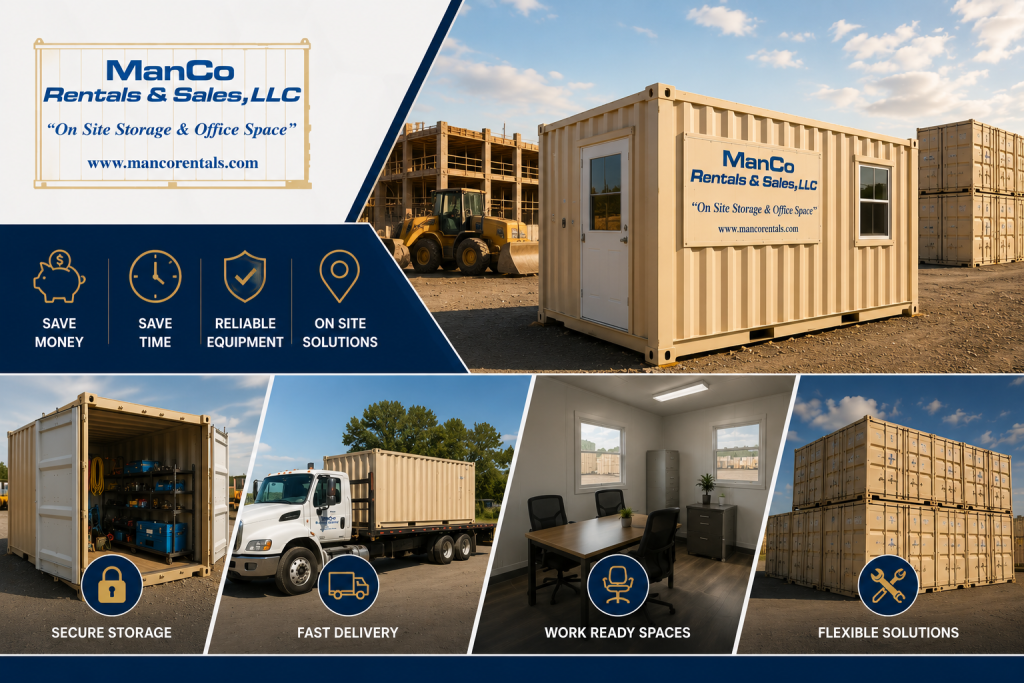
ManCo Rentals & Sales, LLC provides these configurations across the Gulf Coast region with direct delivery to construction sites, oilfield locations, retail operations, farms, and municipal facilities. Contractors evaluating portable job site office buildings as a permanent structure alternative consistently find that the option to rent, lease, or purchase outright means they’re not forced into a single commitment model from the start.
Rental, Lease, Purchase, or Rent-to-Own: What Are the Real Tradeoffs?
| Approach | Acting With ManCo Rentals & Sales, LLC | Going It Alone or Waiting |
| Capital requirement | Matched to active use period only | Full purchase price upfront, plus carrying costs |
| Maintenance burden | Held by provider | Entirely on the owner |
| End-of-use logistics | Provider handles return and redeployment | Owner coordinates transport, storage, or resale |
| Customization access | Finished interiors, electrical, climate control, lockable configurations | Whatever was purchased or built, fixed |
| Quality assurance | Full condition disclosure before agreement | Condition known only after delivery or use |
| Flexibility when timelines shift | Terms adjustable as project phases change | Ownership continues regardless of project status |
| Cost of inaction | Workspace gaps and storage problems accumulate | Same problems persist, compounding through the project |
Ownership builds equity and provides control. Rental preserves cash flow and eliminates residual burden. Neither is universally correct. The honest answer depends on utilization rate: how many days per year the equipment is actively deployed versus sitting idle. When that ratio drops below what justifies full ownership cost, the carrying cost chain is working against you.
When Rental Isn’t the Right Model
Rental doesn’t suit every situation. It’s worth being direct about this.
If your organization uses the same storage or office configuration continuously across 24 or more months with no project gaps, cumulative rental costs will likely approach or exceed a purchase price. In that scenario, a direct purchase through ManCo or a lease-to-own arrangement becomes the more economical path. Operators working through that calculation can review shipping container rental deals and pricing structures to understand how flexible terms affect the long-term cost comparison.
Rental also doesn’t align well with operations that require modifications so proprietary they can’t be reversed or reused on a future deployment. If a customization is specific enough that no other application exists for it, a rental structure creates cost misalignment on both sides.
And for organizations with existing storage infrastructure and in-house maintenance staff, part of the carrying cost chain is already absorbed, which shifts the math. The right answer in those cases isn’t automatically rental. It’s a direct conversation about what configuration actually fits the utilization pattern.
Frequently Asked Questions
How do I figure out if renting a storage container is cheaper than buying one for my project?
Calculate full ownership cost: unit price, delivery, return transport, storage between projects, and upkeep. Then compare that to the rental rate for your active project duration. If your utilization rate falls below active deployment for most of the year, rental typically comes out ahead on a per-use-day basis.
Can I get a container delivered to a remote job site or rural location on the Gulf Coast?
ManCo Rentals & Sales, LLC provides direct delivery across the Gulf Coast region, including rural and remote sites, with both weekday and weekend availability. Delivery logistics are coordinated based on site access conditions, so it’s worth discussing specifics when you request a quote.
What’s the practical difference between a used container and a new one for on-site storage?
Used containers are structurally sound but show wear from prior freight use: surface rust, minor dents, or faded exterior finish. New containers have no prior use history. ManCo fully discloses the condition of all used units before any agreement is signed, so you’re deciding based on actual condition, not assumptions.
Can a rental container be set up as a functioning office, not just lockable storage?
Yes. ISO containers can be fitted with finished interiors, electrical connections, climate control, windows, and custom access configurations. ManCo offers customization options for clients who need a functional on-site workspace, not just a secure storage unit.
What happens if my project runs longer than the original rental term?
Rental terms are adjustable. Most providers, including ManCo, accommodate extensions when timelines shift, which they routinely do in construction and oilfield work. Communicate timeline changes early to avoid any gap in your formal agreement coverage.
Is renting the right approach for a municipality with a longer-term need?
It depends on procurement structure and budget cycle constraints. Municipalities with annual budget allocations often find rental more administratively straightforward than capital purchases. For needs extending beyond two to three years, a lease-to-own or direct purchase arrangement may offer better long-term value. ManCo works with municipal clients on both models.
How quickly can a standard container be delivered once I place an order?
Delivery timelines vary based on unit availability and site location, but Gulf Coast clients typically coordinate delivery within a few business days for standard units. Custom configurations require additional lead time depending on modification scope.
Stop Carrying Costs You Shouldn’t Be Carrying
If you finished this article with a specific project in mind, a storage gap, a workspace problem, or a phase that needs a solution without a permanent commitment, that’s the right moment to act on it.
Contact ManCo Rentals & Sales, LLC to explore rental options, request a quote for your site conditions, and get direct answers about availability, delivery timelines, and customization. No guesswork about condition. No generic catalog. Just a straightforward conversation about what your project actually needs.
Visit mancorentals.com or call to speak with someone who works with Gulf Coast contractors, oilfield operators, farms, and municipalities every day.
References
National Portable Storage Association (NPSA). Industry standards, membership criteria, and cost structure data for portable storage providers
American Rental Association. U.S. equipment rental industry market context and demand drivers