For property owners managing major maintenance cycles, the right rental equipment depends on task frequency, site conditions, and project duration. Grounds tools, structural repair gear, climate management units, and on-site storage infrastructure cover most scenarios. Renting outperforms buying for equipment used fewer than eight months per year when total cost of ownership is calculated honestly.
Key Takeaways
• Renting beats buying for most maintenance equipment when you factor in storage, insurance, upkeep, and depreciation. Not just the purchase price
• Structuring maintenance around four distinct seasonal windows reduces emergency repair costs and keeps equipment available when it’s actually needed
• ISO storage containers solve a specific, underaddressed problem: secure, on-site equipment staging that reduces tool loss, weather damage, and daily retrieval time
• Safety compliance is built into how equipment is selected, staged, and stored. Not treated as a separate checklist item after the fact
• ManCo Rentals & Sales, LLC serves Gulf Coast operators with flexible rental terms, weekday and weekend delivery, and full quality disclosure on all container units
What Equipment Do Property Owners Actually Need for Major Maintenance?
The honest answer: less than most people buy, and more than most people rent.
Property owners routinely over-invest in equipment they use a handful of times per year while under-investing in the on-site infrastructure that makes everything else run. That’s where maintenance budgets quietly erode, and it compounds on every project.
Major maintenance equipment falls into four working categories:
1. Grounds and exterior – mowers, aerators, pressure washers, debris haulers
2. Structural and repair – scaffolding, aerial lifts, air compressors, concrete mixers
3. Climate and seasonal – portable heaters, industrial fans, dehumidifiers
4. On-site infrastructure -ISO storage containers, portable office units, lockable tool staging areas
That fourth category is the one most operators leave off the planning list until a tool goes missing, a subcontractor has nowhere dry to work, or a week’s worth of materials gets ruined by an afternoon thunderstorm.
On-site infrastructure isn’t a nice-to-have. It’s the platform everything else runs on.
Consider a typical Gulf Coast commercial renovation running ten to fourteen weeks. A crew working without dedicated staging space spends a measurable portion of every shift retrieving, restaging, and accounting for tools that weren’t properly stored the night before. A single 20-foot ISO container positioned at the work perimeter eliminates most of that overhead and keeps materials in workable condition across the entire project. The time recovered is real, and the cost of not having it accumulates daily.
How Should You Structure a Seasonal Maintenance Plan?
Most operators plan in two seasons. Effective ones plan in four.
The Four-Window Maintenance Framework, widely referenced in facilities management practice, structures recurring work as follows:
| Window | Timing | Priority Tasks | Equipment Focus |
| Pre-season prep | Four to six weeks before peak use | HVAC checks, exterior repairs, irrigation | Compressors, lifts, pressure washers |
| Active season | During peak occupancy or operations | Grounds, minor repairs, pest control | Mowers, sprayers, portable fans |
| Post-season closedown | Two to four weeks after peak | Drainage, weatherproofing, equipment storage | Dehumidifiers, sealant applicators |
| Off-season audit | Low-activity period | Structural inspection, planning, procurement | Storage containers, portable offices |
The off-season audit window is where most operations lose ground. Low-activity periods get treated as downtime rather than as a window for inspection and procurement work that prevents emergency repairs when the operation is running at full capacity.
Renting during the off-season audit window is often the most cost-effective timing available. Equipment demand is lower, availability is higher, and delivery scheduling is more flexible. ManCo Rentals & Sales, LLC offers weekday and weekend delivery across the Gulf Coast region, which matters specifically during these planning windows when site scheduling is more accommodating and less likely to conflict with active crew work.
Is It Actually Cheaper to Rent Than to Buy?
For most major maintenance scenarios, yes. But the reason is more specific than most operators state.
Buying maintenance equipment isn’t primarily a capital decision. It’s a storage decision. The purchase price is the visible cost. The hidden costs are the space required to store the equipment, the upkeep required to keep it operational, and the depreciation that accumulates whether you use it or not.
The OSHA guidance on workplace resource allocation and the total cost of ownership (TCO) model both point to the same threshold: renting outperforms buying for equipment used fewer than eight months per year when storage, insurance, maintenance, and depreciation are included in the calculation rather than just the sticker price.
Renting makes sense when:
• The task recurs fewer than eight to ten times annually
• On-site storage space is limited or costly
• The equipment requires specialized maintenance you can’t handle in-house
• You need flexibility to scale across multiple sites without moving owned inventory
Purchasing makes sense when:
• Near-daily use would push rental costs past ownership costs within roughly eighteen months
• The equipment is core to your primary operation, not a maintenance support tool
• You have dedicated storage and maintenance staff on-site
For ISO containers specifically, the calculation shifts. Practitioners working with storage infrastructure report functional service lives of twenty or more years with basic upkeep, which makes purchase viable for permanent or semi-permanent installations. If you’re weighing shipping container rental options against outright purchase, ManCo Rentals & Sales, LLC offers both, with transparent quality disclosure on all used units so you’re not guessing at condition when the container arrives on site.
What Does Getting This Wrong Actually Cost?
This is where the math stops being theoretical.
| Decision Point | Acting with ManCo Rentals & Sales | Waiting, Going It Alone, or Using Unqualified Providers |
| Equipment staging | Lockable ISO container on-site from day one; tools secured and accessible | Tools staged from vehicles or open areas; daily retrieval loss, weather exposure, theft risk |
| Delivery logistics | Weekday and weekend delivery across Gulf Coast, confirmed in advance | Scrambling for availability mid-project; delays compound labor costs |
| Container condition | Full quality disclosure on new and used units before delivery | Unknown prior use, undisclosed wear, or condition surprises discovered on arrival |
| Rental terms | Flexible leasing structured to match project or seasonal timelines | Rigid contracts or overpaying for duration that doesn’t match your actual schedule |
| On-site workspace | Portable office available for coordination, paperwork, and subcontractor meetings | Administrative work handled from truck cabs or off-site; daily productivity loss |
| Long-term cost | Right-sized solution matched to actual workload from the start | Cost overruns from deferred decisions, lost equipment, and unplanned downtime |
The expensive option in this comparison isn’t a qualified provider. It’s inaction, improvisation, or working with a supplier who can’t deliver on your schedule or won’t disclose what they’re selling you.
What Safety and Efficiency Standards Apply to On-Site Equipment Use?
Equipment safety isn’t a checklist you complete at the start of a job. It’s a system that shapes how equipment is selected, staged, and stored throughout the entire project.
The OSHA Hazard Communication Standard (HCS) requires that all hazardous materials and equipment operating instructions remain accessible at the point of use. For property maintenance operations, that means storage and staging solutions need to be organized, labeled, and accessible, not just physically present somewhere on the site.
Efficiency practices that directly reduce incident rates include:
• Stage equipment as close to the work area as practical. Retrieval distance is a fatigue multiplier that compounds across a full shift.
• Use lockable, weather-resistant storage for tools and chemicals between work periods.
• Designate a single check-in and check-out point for equipment to prevent loss and misuse.
• Maintain a written equipment condition log. It’s the most underused practice in small-to-mid-size property operations, and it’s free.
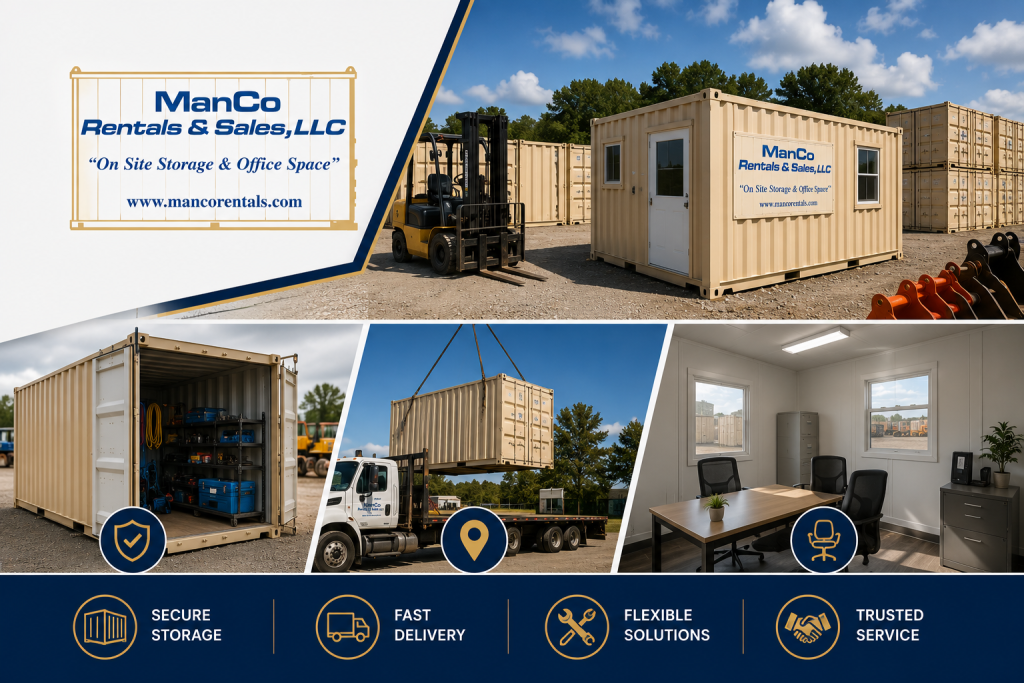
A lockable ISO container positioned at the work perimeter does three things simultaneously: it secures equipment overnight, it cuts retrieval time during the workday, and it provides a weather-protected staging area that keeps tools and materials in operational condition. For Gulf Coast operators where afternoon thunderstorms are a routine variable rather than an exception, that third function alone recovers meaningful hours across a full project. Operators evaluating on-site storage for Louisiana job sites will find that ManCo containers ship with lockable doors as a standard feature, covering all three functions without additional modification.
Where This Approach Doesn’t Work
Not every operation is a fit for rental-based equipment strategy.
Renting is a poor match when your maintenance program requires the same specialized equipment continuously for more than six months at a stretch. At that utilization rate, purchase economics typically win when you run a genuine cost comparison.
Rental also requires lead time. If your maintenance approach is reactive rather than planned, meaning you respond to failures rather than prevent them, rental logistics may not align with your urgency window. Same-day availability for specialized equipment isn’t guaranteed from any regional provider, and that’s an honest constraint worth acknowledging.
This guide is least applicable for large facility operators with dedicated in-house maintenance fleets and full-time equipment staff, or for operations where regulatory compliance specifically requires owned and certified equipment on-site.
There’s also an administrative tradeoff worth naming: rental terms, delivery scheduling, and return logistics add coordination overhead. For a solo property owner managing a single small site with a basic tool set, that overhead may outweigh the financial benefit. The framework here is built for operators running active, multi-task maintenance cycles across single or multiple sites, not occasional single-task jobs.
FAQ: Questions From Property Operators
How do I determine what size storage container I need for a maintenance operation?
Start with your largest single piece of equipment and work outward from there. A 20-foot ISO container provides roughly 1,160 cubic feet of usable interior space, which is sufficient for most small-to-mid-size maintenance tool inventories. If you’re staging materials alongside tools, a 40-foot unit gives you room to organize by task category without stacking. ManCo Rentals & Sales, LLC can walk you through sizing based on your specific inventory and site layout.
Can I rent a container for a single season without a long-term commitment?
Yes. Flexible rental terms exist specifically for seasonal use cases. ManCo structures leasing options to accommodate short-term and project-based needs, which is common for agricultural and construction clients on seasonal operating schedules along the Gulf Coast.
What’s the practical difference between a new and a used ISO container for storage?
New containers offer pristine condition, no prior cargo exposure, and full structural integrity from day one. Used containers are functionally equivalent for most storage and staging purposes and cost less. The tradeoff is cosmetic wear and, in some cases, minor surface rust that doesn’t affect structural performance. ManCo fully discloses the condition of every used container before delivery, so there’s no guesswork when the unit shows up.
Is a portable office unit worth renting for a short project?
If your project runs more than three weeks and involves any administrative coordination, subcontractor meetings, or client-facing activity, the answer is yes. A portable office unit eliminates the productivity loss of running paperwork from a truck cab or driving off-site for phone calls. The cost is typically recovered within the first week of avoided inefficiency.
Who’s responsible for equipment maintenance during the rental period?
Routine operational care during the rental period is typically the renter’s responsibility. Structural or mechanical failure resulting from normal use is covered by the rental provider. Read your rental agreement carefully, specifically the sections that define damage thresholds and return condition requirements.
What equipment is most commonly overlooked in seasonal maintenance planning?
Dehumidification equipment and drainage tools. Most operators plan well for visible tasks like grounds work, HVAC servicing, and exterior repairs, but underplan for moisture management. In Gulf Coast climates, humidity-related damage to stored materials and equipment is a persistent, preventable cost driver that doesn’t announce itself until it’s already expensive.
Can ISO containers be delivered to remote or rural sites?
Yes, with advance coordination. ManCo Rentals & Sales, LLC provides direct delivery across the Gulf Coast region, including rural agricultural and oilfield locations. The key variable is site access. A level, accessible drop point is required for safe container placement. Confirm your site conditions with ManCo before scheduling delivery so nothing slows down the project on arrival day.
Match Your Equipment to Your Actual Workload
You’ve got the seasonal framework, the rent-versus-buy thresholds, and a clear picture of the on-site infrastructure gaps that quietly drain maintenance budgets when they’re left unaddressed.
The next step is direct: contact ManCo Rentals & Sales, LLC with your site location, project timeline, and storage or workspace requirements. Their team will recommend the right container size, rental term, and delivery window for your operation.
Reach out at mancorentals.com to get started.
References
OSHA Hazard Communication Standard (HCS) – Requirements for equipment and materials accessibility at the point of use in workplace settings
National Portable Storage Association (NPSA) – Industry standards and membership criteria for portable storage providers; ManCo Rentals & Sales, LLC has been a member since 2007
Facilities Management Journal / Four-Window Maintenance Framework – Widely referenced seasonal maintenance planning structure used in commercial and industrial facilities management practice
Total Cost of Ownership (TCO) Model – Standard financial methodology for comparing rental versus purchase decisions based on full lifecycle cost rather than purchase price alone