Major property maintenance projects demand more than weekend effort. They require the right equipment class matched to actual project scope. Earthmoving, debris handling, on-site material storage, lifting, and compaction each serve a distinct function. Renting professional-grade equipment for a defined project period costs less than ownership for work performed fewer than eight months per year, and significantly less than the compounding damage that results from using undersized tools.
Key Takeaways
• Match equipment class to project output, not just project type. Debris volume and site access constraints determine what you actually need
• On-site ISO container storage prevents material loss and weather damage during multi-phase renovations more reliably than tarps or garage staging
• Renting is almost always cheaper for equipment used fewer than 8 months per year
• Seasonal demand peaks in spring and fall. Book two to three weeks ahead to avoid availability gaps
• Confirm operator orientation and utility marking before any earthmoving equipment runs, not after delivery
What Actually Makes a Maintenance Project “Major”?
The distinction isn’t dollar amount. It’s whether the work exceeds the capacity of standard household tools, generates material volume that requires dedicated handling, or involves equipment a homeowner can’t safely operate without instruction.
Tree removal, French drain installation, foundation grading, roof replacement, and large-scale brush clearing all qualify. These projects share a common trait: they produce something that needs to go somewhere, and managing that output is often where homeowners lose control of the timeline and budget.
Scope creep is the real threat. A project framed as “cleaning up the back half-acre” can expand into brush removal, stump grinding, soil grading, and a full debris haul. Four separate equipment categories. Homeowners who plan for one phase and encounter four end up renting the wrong tools twice and paying more than a contractor would have charged upfront.
Which Equipment Categories Cover Most Large Residential Projects?
Earthmoving and Grading
Mini excavators and skid steers handle drainage correction, lot grading, and land clearing. A properly sized mini excavator can complete in a single day what a hand crew takes a week to accomplish on a 5,000-square-foot lot. The operative word is “properly sized”. Renting a unit below the required operating capacity because the day rate is lower is one of the most common and costly homeowner rental mistakes.
Debris and Material Handling
Roll-off containers and dumpsters manage waste volume. For any project generating more than two full pickup truck loads of debris, a roll-off is almost always cheaper per cubic yard than making repeated haul trips. That math holds even after factoring in delivery and pickup fees.
On-Site Storage
This is the category most homeowners omit until the project exposes why it matters.
ISO shipping containers. The same lockable, weatherproof units used across construction, oilfield, and agricultural operations. Provide stable, secure material staging for multi-phase residential projects. A homeowner running a six-week exterior renovation needs somewhere to store roofing materials, trim lumber, fasteners, and tools that isn’t the garage or a tarp on the lawn.
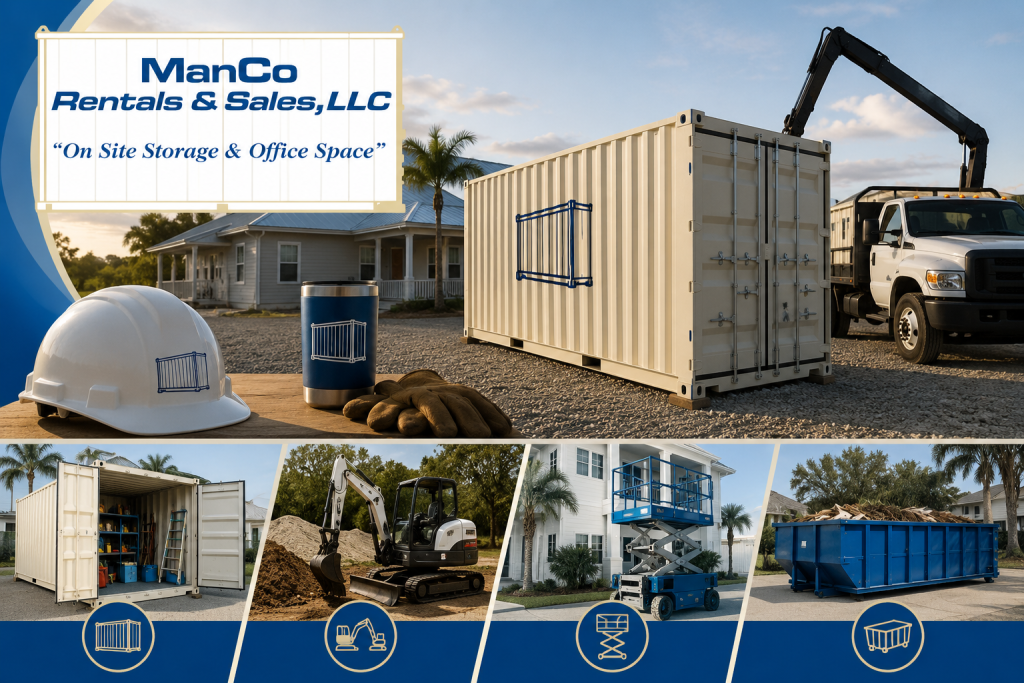
Shipping container storage in Louisiana offers a level of protection against theft and weather that improvised staging simply can’t match. ManCo Rentals & Sales, LLC supplies 20-foot and 40-foot ISO containers for residential and commercial use across the Gulf Coast, with weekday and weekend delivery and flexible rental terms built around actual project timelines.
Lifting and Access
Boom lifts and scissor lifts cover exterior painting on two-story structures, tree trimming, and roofline access. According to the U.S. Bureau of Labor Statistics, falls from elevation remain one of the leading causes of serious injury in residential maintenance work. Renting a lift for a single day is a measurable safety decision, not a luxury.
Compaction and Surface Preparation
Plate compactors and jumping jacks are non-negotiable for any project involving gravel, pavers, or base material installation. Skipping compaction is the primary reason driveways and patios fail within three years of installation.
Power Generation
Generator rentals cover remote project areas, temporary power outages, or any site where running extension cords across a large yard creates a trip or load hazard.
How Do You Choose the Right Equipment Without Overspending?
The Project-Equipment Fit Matrix is a practical tool for matching equipment class to project scope before you call a rental provider. It uses three variables: project duration, output volume, and site access constraints.
| Variable | Light Residential | Major Residential | Commercial-Scale |
| Project Duration | 1-2 days | 3-21 days | 22+ days |
| Debris or Material Volume | Under 1 ton | 1-10 tons | 10+ tons |
| Site Access | Standard driveway | Requires delivery coordination | Requires site prep |
| Storage Need | None | Temporary ISO container | Permanent or semi-permanent |
| Equipment Class | Hand tools, small rentals | Mid-class rentals, ISO container | Full commercial fleet |
This matrix exists to prevent a specific, recurring mistake: renting light-duty equipment for a heavy-duty job because the lighter unit had a lower day rate. The savings on the rental disappear when the equipment fails to complete the work, requires a second delivery, or causes collateral damage it wasn’t rated to avoid.
Is Renting Actually Cheaper Than Buying?
Renting is almost always cheaper for equipment used fewer than 8 months per year. That threshold reflects standard equipment depreciation modeling applied to residential use patterns. A homeowner using a plate compactor four days annually at a $75 daily rental rate spends $300 per year. Ownership of the same unit, accounting for depreciation, storage, maintenance, and insurance, runs considerably higher. And that’s before the equipment needs its first service.
The contrarian point worth stating plainly: most homeowners who buy equipment to “save money” are paying a premium for the convenience of having it available on demand. They use that convenience fewer times than they expect before the equipment requires service or sits idle for years.
Ownership does make sense in specific circumstances. A homeowner who needs permanent, year-round on-site storage is better served by purchasing an ISO container outright than renting one indefinitely. ManCo Rentals & Sales, LLC offers both rental and sales options on new and used shipping containers in Louisiana, with full quality disclosure on every used unit so the decision is based on actual use patterns, not a default toward one option or the other.
Acting with the Right Provider vs. Going It Alone
Consider a typical case: a homeowner plans a six-week exterior renovation involving roofing, trim replacement, and concrete pad work. Materials arrive in phases. Tools need to stay on-site overnight. Debris accumulates before the final haul.
Without proper staging, materials sit exposed to Gulf Coast summer weather. Without a lockable container, tools are vulnerable overnight. Without the right earthmoving class, the concrete prep takes three days instead of one.
| Situation | Without ManCo / Going It Alone | With ManCo Rentals & Sales, LLC |
| Material staging | Tarps, garage overflow, weather exposure | Lockable ISO container, delivered to site |
| Equipment fit | Light-duty rental, possible rework | Right-sized unit matched to project scope |
| Delivery coordination | Self-arranged, availability uncertain | Weekday and weekend delivery, confirmed upfront |
| Rental term flexibility | Fixed minimums, calendar mismatches | Terms aligned to actual project timeline |
| Quality disclosure on used units | Unknown condition until arrival | Full disclosure before truck leaves the yard |
| Total cost exposure | Higher from material loss, rework, re-rental | Controlled from day one |
The expensive option isn’t working with a qualified provider. It’s the material losses, rework costs, and timeline delays that come from making do with inadequate equipment or improvised staging.
What Safety Steps Are Non-Negotiable Before Operating Rented Equipment?
Rented equipment doesn’t come with assumed operator competency. That’s not a warning label. It’s a functional reality that changes how you prepare.
The American Rental Association recommends equipment-specific operator orientation before first use. The failure modes of unfamiliar equipment aren’t intuitive. A skid steer handles differently on a slope than on flat ground. A boom lift has a rated wind speed limit that matters. A plate compactor can damage underground utilities when the operator doesn’t know the site.
Three steps before any rented equipment runs:
1. Call 811 before any earthmoving work to mark underground utilities through the national Common Ground Alliance service
2. Request an operator walkthrough from the rental provider at delivery, not before you call
3. Confirm load ratings and ground conditions before positioning any heavy equipment on driveways, slopes, or soil that’s been softened by rain
ManCo Rentals & Sales, LLC delivers directly to Gulf Coast properties and provides upfront quality disclosure on all container units, so what arrives matches what was agreed on. No condition surprises on delivery day.
Does Seasonal Timing Affect Equipment Availability?
It does, and planning around it is practical rather than optional.
Spring is peak season for grading, drainage correction, and land clearing across the Gulf Coast. Mini excavators and skid steers are in highest demand from April through June. Booking two to three weeks ahead during this window isn’t excessive. It’s the window that keeps your project from waiting on equipment that’s already committed.
Summer projects focus on exterior construction, concrete and paver work, and deck builds. Schedule heavy earthwork early in the day; Gulf Coast heat affects both operator endurance and material performance in ways that add hours to a job.
Fall brings tree work, drainage maintenance, and debris volume from seasonal clearing. On-site storage containers are especially practical here. Materials staged before early rain arrives stay dry and accessible without requiring a climate-controlled structure.
When Renting Equipment Isn’t the Right Answer
Not every project belongs in a homeowner’s hands, regardless of what equipment is available to rent.
Renting a mini excavator doesn’t transfer the knowledge required to operate it safely near a foundation, a septic system, or a utility easement. The equipment is only half the equation. Projects that require licensed work, electrical, structural, gas line, or permitted excavation, aren’t solved by equipment access alone.
This isn’t about capability in general. It’s about specific situations where the cost of a mistake is structural or irreversible. Getting the scope wrong on a drainage project adjacent to a foundation isn’t a setback you recover from with a second rental.
Frequently Asked Questions
How far ahead do I need to book equipment for a weekend project?
For standard storage containers and small earthmovers, one to two weeks is typically adequate outside of peak spring and fall demand. For specialty equipment or delivery to remote or rural Gulf Coast sites, two to three weeks gives the provider time to confirm availability and coordinate logistics without compressing delivery timelines.
Can I rent a shipping container for just a few weeks during a renovation?
Short-term ISO container rentals are a standard offering, not a special arrangement. ManCo Rentals & Sales, LLC structures rental terms around actual project duration, whether that’s two weeks or six months. You pay for the time the project requires.
What container size is right for a home renovation project?
A 20-foot ISO container holds roughly the equivalent of a one-car garage, which covers most single-phase renovation projects. A 40-foot unit makes sense when staging materials for multiple trades simultaneously or when the project runs long enough that material needs rotate. When in doubt, size up. The cost difference between units is smaller than a second delivery.
Does homeowner’s insurance cover rented equipment if something goes wrong?
Most homeowner’s policies don’t cover liability or damage arising from the operation of rented heavy equipment. Check your policy before the equipment arrives, and ask the rental provider about damage waiver options. Earthmovers and lifts carry meaningful damage exposure that a standard residential policy typically won’t address.
What’s the difference between renting a dumpster and renting a storage container?
A dumpster is designed for waste removal. It gets filled and hauled away. A storage container is designed for secure staging of materials and tools you still need access to. They solve different problems. Using a dumpster as a material storage solution is a common mistake that results in damaged stock and wasted rental cost.
Do rental companies deliver to residential addresses?
Most container providers serve residential addresses, but delivery logistics vary by provider and location. ManCo Rentals & Sales, LLC delivers to residential and commercial properties across the Gulf Coast region on weekdays and weekends, with delivery coordination handled upfront.
How do I confirm a used container is in acceptable condition before I agree to delivery?
Ask for explicit quality disclosure before confirming the order. A reputable provider describes condition in specific terms: structural integrity, door seal function, floor condition, and any visible rust or repair history. ManCo Rentals & Sales, LLC fully discloses the quality of every used container before delivery, so there are no condition surprises when the truck arrives.
Get the Right Equipment on Your Site Before the Project Starts
You know the equipment categories, the cost thresholds, the seasonal timing, and the safety requirements. The next step is a direct conversation about your specific project, site, and timeline.
Contact ManCo Rentals & Sales, LLC to talk through what your project actually needs. They’ll match the right equipment to your scope, handle delivery logistics, and confirm everything upfront so the equipment is on-site when the work starts.
References
U.S. Bureau of Labor Statistics. Occupational injury and fatality data, including falls from elevation in residential and construction settings.
American Rental Association. Operator safety guidelines and equipment orientation recommendations for rental equipment users.
Common Ground Alliance / Call 811. National utility marking service for excavation safety prior to any digging work.